
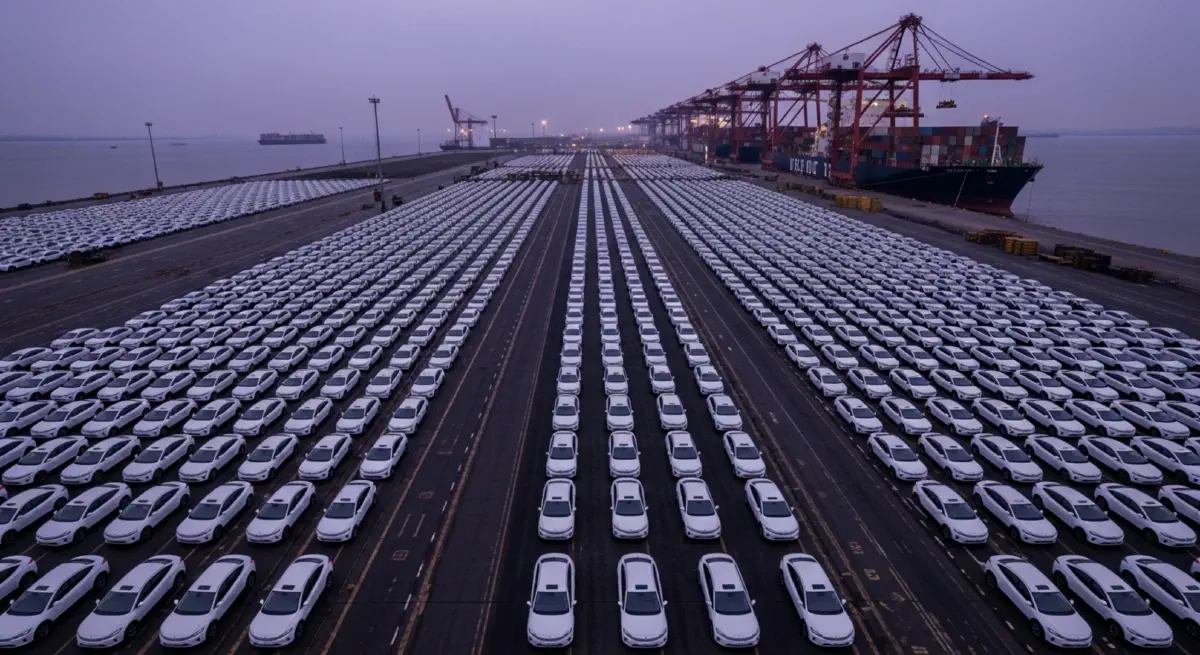
A Quantitative Snapshot of Global Market Supremacy#
In 2023, the Chinese automotive industry manufactured 30.161 million vehicles. To the uninitiated, this is a large number; to those who manage global trade, it is an industrial blunt-force trauma. For the first time in history, a single nation has breached the thirty-million-unit production threshold, selling 30.094 million units in the same twelve-month window. To find a comparable scale of automotive gravity, one must combine the total outputs of multiple former industrial leaders, none of whom possess the structural velocity currently displayed by the factories in the Yangtze and Pearl River Deltas. This is not merely growth; it is the physical manifestation of a multi-decade plan to relocate the center of global mobility to the East, an objective that transitioned from ambition to arithmetic somewhere between the 2009 milestone and the record-breaking export surges of the present.
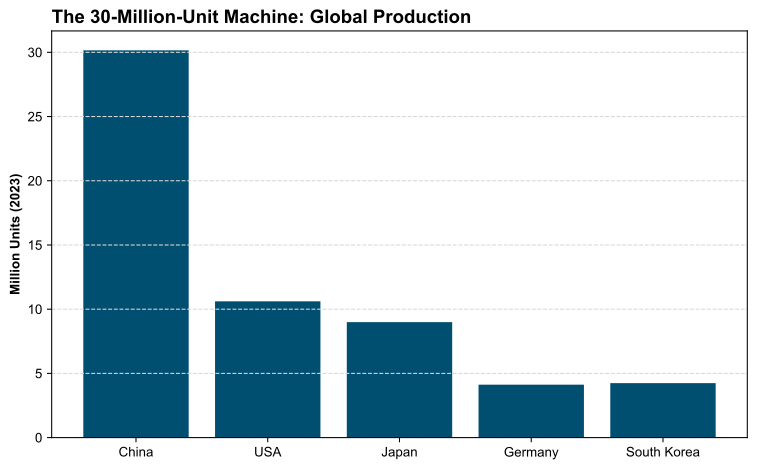
The numerical supremacy is most evident when contrasted against the stagnant or declining shares of legacy powers. China has served as the world’s largest automobile producer since 2009, having systematically dismantled the production leads formerly held by the United States, Japan, and Germany. While the global market contracted or buckled under the weight of the COVID-19 pandemic, the Chinese supply chain demonstrated a resilience that resulted in the smallest decline among competitors, followed by a rapid, asymmetric recovery. By the end of 2024, total vehicle sales are projected to climb further to 31.44 million units. This relentless expansion is supported by an annual productivity growth rate within the automotive sector of 10.7%, a figure that makes the incremental gains of Western manufacturers look like administrative errors.
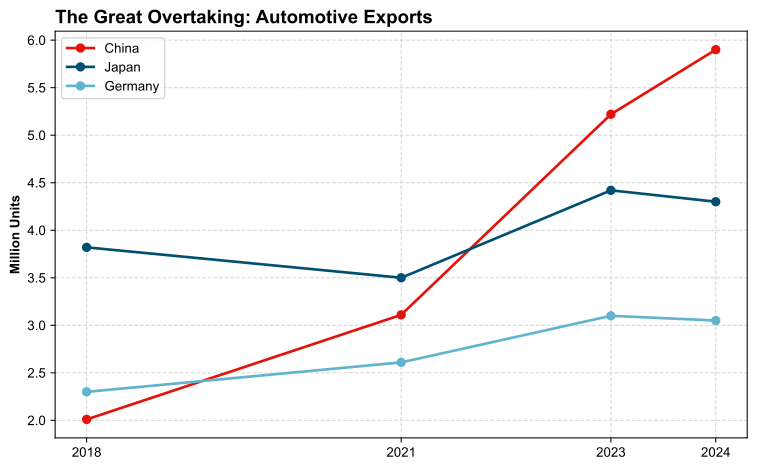
The most jarring shift, however, is not found in what China builds for itself, but in what it sends elsewhere. In 2022, China surpassed Germany to become the world's second-largest automotive exporter. By 2023, the momentum was undeniable as China overtook Japan for the top global position, shipping 5.22 million vehicles. Preliminary data for 2024 indicates this figure has risen to 5.9 million vehicles, representing a 60% growth rate compared to 2022. Mexico has emerged as the single largest destination for these exports, absorbing nearly 10% of the total share, followed by Russia and the United Arab Emirates. This export surge is not a temporary vent for overcapacity; it is a calculated entry into the world’s developing markets, where Chinese brands now compete on price points that Western engineering is structurally incapable of meeting.
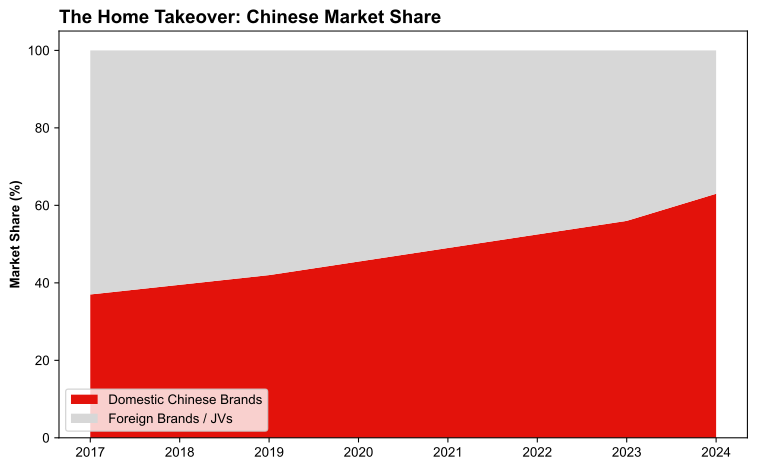
The transition to New Energy Vehicles (NEVs) provides the statistical heart of this transformation. In 2023, China produced 9.587 million NEVs and sold 9.495 million, securing a 31.6% market penetration rate. By early 2024, this penetration reached 41%. To appreciate the scale of this dominance, one must look at the global context: China accounts for roughly 70% of all electric vehicles sold worldwide. More than half of all electric vehicles sold globally in 2023 were produced in Chinese factories. The domestic market is equally lopsided; domestic Chinese brands now capture 80% of the home NEV market, a shift that has seen foreign joint ventures' share of top-ten vehicle sales plummet from 18% in 2017 to 63% being held by local players in 2024.
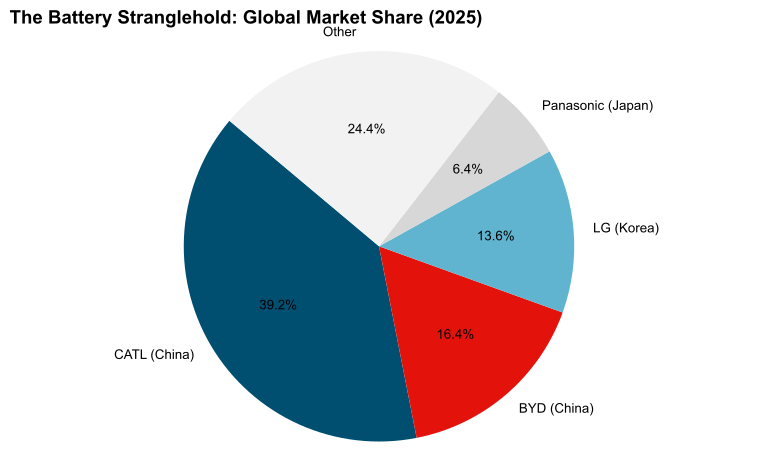
While Western boards of directors debated the viability of lithium-ion technology, China built the supply chain. Today, the nation leads 11 of 12 segments of the lithium-ion battery supply chain. This includes a greater than 98% share in Lithium Iron Phosphate (LFP) production, the very chemistry that has become the industry standard for mass-market EVs. Two entities, CATL and BYD, effectively dictate the terms of global electrification. As of late 2025, six Chinese manufacturers, led by these titans, controlled 68.9% of the global EV battery market. CATL alone holds a 39.2% global share, while BYD follows with 16.4%.
The control extends further upstream into the mineral refinery, creating a technological moat that cannot be bridged by mere capital investment. China refines approximately 70% of the world's energy-related minerals. This includes a 90% share of rare earth elements and 85% of graphite. Even as the nation faces a 75.7% import dependence for raw lithium, it has positioned itself as the world’s indispensable midstream refinery, ensuring that any nation attempting to build a domestic EV industry must eventually negotiate with Beijing for the refined components required to make a car move. This mineral security is the silent engine behind the 2030 projection that NEVs will represent 55% of the total passenger vehicle market.
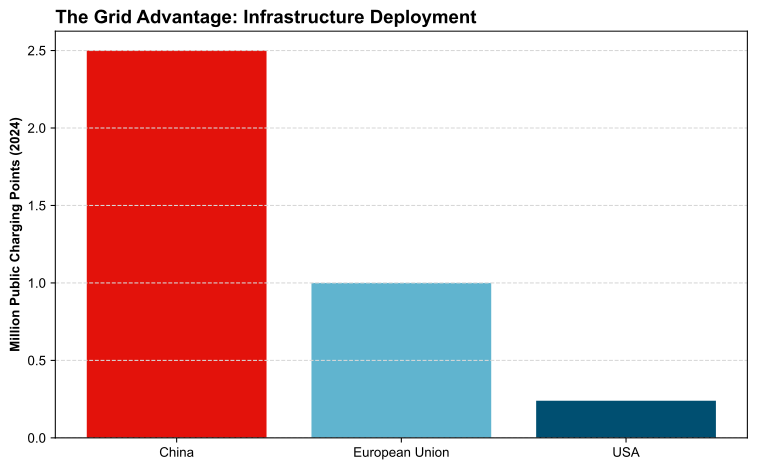
The infrastructure supporting this fleet is equally unprecedented. By late 2024, China recorded over 2.5 million public charging points, representing over 60% of the global stock. When private charging units are included, the total exceeded 20.09 million by the end of 2025. This network provides more than double the public charging capacity per vehicle compared to the United States, offering 3 kW (~4 HP) of capacity per electric vehicle. The density of this grid has effectively removed range anxiety as a barrier to purchase, allowing NEV sales to grow by 35–38% year-on-year in 2023 even as direct subsidies were phased out.
Within the manufacturing plants, the dynamics are characterized by a brutal rationalization. The industry is hyper-competitive, with firm entry rates of approximately 13.7% annually and gross turnover rates reaching 32–40%. This industrial churn has increased the average production scale per firm from fewer than 7,000 units in 1991 to over 246,000 units by 2012. Yet, the success has birthed a new crisis: structural overcapacity. Current annual manufacturing capacity is estimated at 50–60 million vehicles, nearly double the domestic demand of 30 million. This surplus is the pressure valve that will continue to drive Chinese exports into international markets at prices that trigger protective tariffs in Europe and the United States.
The workforce itself has undergone a qualitative shift. While traditional manufacturing remains significant, there is a clear migration toward high-tech and Information and Communication Technology (ICT) skills within the NEV sector. This shift is regionally concentrated in Eastern China—specifically in Jiangsu, Zhejiang, Guangdong, Shanghai, and Beijing—where specialized industrial clusters for batteries and semiconductors have been co-located to minimize logistics friction. In provinces like Ningbo alone, there are over 4,000 auto suppliers supporting the production lines of domestic giants like Geely and joint ventures like SAIC-Volkswagen.
The technological frontier is also being pushed beyond basic electrification into the realm of intelligent-connected vehicles. Projections for 2030 suggest that 20% of all cars sold in China will be fully autonomous, with 70% equipped with advanced driver-assist systems (ADAS). By the end of 2024, 18 million electric vehicles were already connected to a national monitoring platform, providing real-time data on battery health and usage patterns that Western OEMs can only envy from afar. The entry of tech conglomerates like Xiaomi and Huawei into the sector has further accelerated this "Foxconnisation" of automotive production, where the car is treated as a high-compute consumer electronic device.
Safety and recall systems, historically a point of Western criticism, are evolving to meet global standards. While recall frequency reached nearly once every two days between 2008 and 2017, the performance is still viewed as lagging behind US benchmarks. However, the rise of domestic brand equity suggests that consumers—both at home and increasingly abroad—are no longer prioritizing perceived foreign quality over Chinese innovation. Domestic brands have closed the quality gap, particularly in the premium NEV segment where they now compete directly with legacy luxury marques.
The final piece of the 30-million-unit puzzle is the dominance of the domestic brand. Foreign joint ventures, which once served as the "cash cows" for global giants like Volkswagen and General Motors, are in a state of managed retreat. Their passenger market share fell to approximately 35% by early 2024 as domestic players like BYD, Geely, and Chery captured 56% of the market. In the electric sector, the takeover is absolute; BYD’s NEV sales alone grew by 231.6% in 2021, reaching 593,700 units and setting the stage for its current position as a global volume leader.
As we look toward 2030, the forecasts remain bullish. Total vehicle sales are expected to settle between 32.5 and 40 million units annually. NEV penetration is projected to exceed 75% of new sales. Battery technology is slated to reach an energy density of 350 Wh/kg by 2025, allowing for routine driving ranges exceeding 700 km (~435 miles). These are not just targets; they are the logical outputs of a machine that has already secured the raw materials, the refining capacity, the manufacturing scale, and the infrastructure grid.
The world is currently witnessing the conclusion of an industrial era. The global automotive industry was once a Western club with Japanese guest membership, defined by the mastery of the internal combustion engine. By reaching 30 million units of production and securing the entire value chain of the electric future, China has not just joined the club; it has bought the building, rewritten the rules, and is now deciding who is allowed to keep their membership. The shock being felt in the boardrooms of Wolfsburg and Detroit is not the result of a sudden change in the market; it is the realization that the numbers have finally caught up with the strategy.