Now we turn the lens on the United States.
If a developing country came to us for advice, we would warn against unconditional protection, political capture of industrial policy, and the short‑termism of shareholder‑primacy capitalism. We would prescribe high initial policy stringency, conditional technology transfer, export mandates, and strong autonomous institutions.
The United States violates nearly every one of these prescriptions. And the result, after half a century of policy failure, is an automotive industry that has repeatedly been bailed out, protected, and coddled, yet remains chronically behind in the technologies of the future.
This is not an opinion. It is a historical record. Let me walk through the evidence.
1. The 1970s Oil Crisis and the VERs: Protection Without Performance#
When the 1973 oil embargo struck, American drivers discovered that Japanese cars were smaller, more fuel‑efficient, and better engineered. By 1982, Japanese cars had captured 30 percent of the U.S. market. Detroit was caught flat‑footed.
Instead of forcing domestic firms to restructure, the U.S. government pressured Japan to accept voluntary export restraints (VERs). In May 1981, Japan agreed to limit passenger car exports to 1.68 million units per year. The cap was later raised to 1.85 million in 1984 and 2.3 million in 1985, but the program lasted until 1994.
What did this protection achieve? It raised the prices of Japanese cars by about 14 percent, costing American consumers an estimated $13 billion (in 1983 dollars). U.S. automakers gained about $2 billion per year in extra profits. The net welfare loss to the U.S. economy was about $3 billion. The VERs did not force Detroit to innovate; they simply postponed the reckoning.
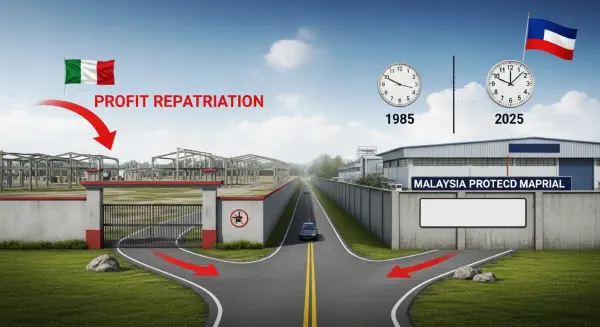
This is protection without performance: the Malaysia trap, dressed in American flags.
2. The Chrysler Bailout (1979): A Rescue Without Restructuring#
In 1979, Chrysler teetered on the edge of bankruptcy. President Carter signed the Chrysler Corporation Loan Guarantee Act, authorizing up to $1.5 billion in federal loan guarantees.
The act required Chrysler to raise matching funds from private sources, accept labor concessions, and submit a turnaround plan. The government created a Loan Guarantee Board to oversee the process.
But critically, there was no mandate to produce small, fuel‑efficient cars. Chrysler did not have to abandon its reliance on large vehicles. It did not have to meet technology transfer milestones or export targets. The bailout kept the company alive, but it did not force the deep restructuring that would have made it competitive.
This is unconditional protection. And it set a precedent for every subsequent auto bailout.
3. The Reagan Era: Rolling Back Safety and Fuel Economy#
The Reagan administration came into office promising deregulation. The auto industry was a prime beneficiary.
- In 1981, Reagan canceled energy‑saving standards for federal buildings, which had saved the government $700 million per year.
- He refused to issue motor vehicle efficiency standards for the next decade and allowed General Motors and Ford an exemption from the 27.5 mpg fleet average standard.
- The administration proposed rolling back CAFE standards from 27.5 mpg to 26 mpg for the 1986 model year.
- It also pushed to eliminate rules requiring high‑altitude emissions compliance and bumper crash‑worthiness standards.
The administration’s goal was explicit: repeal CAFE entirely. “The marketplace alone should determine what cars would be made and sold”.
But markets, left to themselves, do not produce safety or fuel economy; they produce profits. And profits, for Detroit, meant large vehicles.
4. The Ford Pinto Memo: The Shareholder‑Primacy Logic in its Purest Form#
The Ford Pinto case is not a footnote. It is the logical conclusion of Milton Friedman’s doctrine.
An internal Ford memo, titled “Fatalities Associated with Crash‑Induced Fuel Leakage and Fires,” estimated that fixing the Pinto’s fuel‑tank defect would cost $11 per vehicle. The alternative, paying out lawsuits, was cheaper. The memo calculated 180 burn deaths at $200,000 each, 180 serious injuries at $67,000 each, and 2,100 burned vehicles at $700 each, for a total “benefit” of $49.5 million.
The $200,000 per death figure was not Ford’s invention. It came from the National Highway Traffic Safety Administration (NHTSA), the official Value of a Statistical Life (VSL) at that time.
This is what shareholder primacy looks like in practice: a cold calculation that human life is a cost to be minimized, not a value to be protected.
5. Who Killed the Electric Car? The EV1 Story#
In 1990, the California Air Resources Board (CARB) adopted the Zero Emission Vehicle (ZEV) mandate, requiring that 2 percent of new vehicles sold in California be emission‑free by 1998, rising to 10 percent by 2003.
General Motors responded with the EV1, the first modern, purpose‑built electric vehicle from a major automaker. It was a technological marvel: a drag coefficient of 0.19 Cd (compared to 0.3–0.4 for production cars), regenerative braking, and keyless entry. It was lease‑only, but waiting lists were long and customers loved it.
Yet in 2003, GM canceled the program. All 1,117 EV1s were recalled, and nearly all were crushed. GM claimed the EV1 was not profitable. But the deeper reason was that the EV1 threatened GM’s core business: parts, service, and the dealer franchise system. An electric car has far fewer moving parts. It does not need oil changes, mufflers, or frequent brake maintenance. The entire after-market revenue stream, a billion-dollar industry, was at risk.
The 2006 documentary Who Killed the Electric Car? chronicles this story, implicating automakers, oil companies, the federal government, and even CARB itself. The EV1 was not a commercial failure; it was a deliberate killing of a technology that threatened incumbents.
6. Milton Friedman and the Ideology of Shareholder Primacy#
In his 1970 New York Times Magazine essay, Friedman argued that “the sole purpose of a company is to serve its shareholders” and lampooned the idea that business has any responsibility for “providing employment, eliminating discrimination, avoiding pollution and whatever else may be the catchwords of the contemporary crop of reformers”.
This doctrine has been disastrous for long‑term industrial capability. CEOs are compensated with stock options that vest in 3–5 years. Why invest in a 10‑year EV platform when you can buy back shares and boost the stock price today? Shareholder primacy is short‑termism institutionalized.
The U.S. auto industry is the living embodiment of this logic. Every decision is evaluated through the lens of quarterly earnings, not national competitiveness.
7. The IRA and Its Dismantling: The 180‑Degree Policy Flip#
The Inflation Reduction Act of 2022 was a rare deviation from this pattern. It created conditional protection for EV manufacturing:
- Final assembly in North America required for the $7,500 consumer tax credit.
- 50 percent of critical minerals had to be sourced from North America or U.S. allies by 2024, rising to 80 percent by 2026.
- The Section 45X manufacturing credit subsidized domestic production of batteries and components.
This was the kind of conditional, performance‑linked policy our model recommends. For a brief moment, the U.S. was acting like a developmental state.
That moment is ending.
In July 2025, final reconciliation legislation repealed the 30D clean vehicle credit for vehicles acquired after September 30, 2025, and eliminated the 45W commercial EV credit. The Section 45X manufacturing credit will expire for wind components after 2027, with critical minerals phaseout beginning in 2031. An Executive Order signed by President Trump on July 7, 2025, directed the Treasury Department to strictly enforce the termination of clean energy production tax credits.
The Trump transition team has also proposed cutting off support for EVs and charging stations, redirecting funds to national defense, and eliminating California’s Clean Air Act waiver.
This is not a policy adjustment. It is a 180-degree reversal for an industry that requires 5–10 year planning horizons.
8. The Costs of Policy Inconsistency#
The CSIS analysis warns that “encouraging the localization and diversification of critical mineral and battery supply chains should remain a U.S. priority,” and that “killing the U.S. EV market and politicizing EVs will not help strengthen the U.S. innovation ecosystem; it may succeed only in isolating the U.S. from the rest of the world”.
Without the IRA’s incentives, up to 72 percent of existing and planned battery cell manufacturing capacity in the U.S. is at risk of closure. The uncertainty alone has already delayed investment decisions. As one analysis notes, “large investments from industry were planned with the assumption of long‑term policy stability, an assumption that is now in doubt.”
This is policy volatility functioning exactly like rent‑seeking: it diverts resources from productive investment toward hedging, lobbying, and delay.
9. What the Model Would Prescribe for the U.S.#
If the United States came to us as a client, our diagnosis would be brutal:
You have no autonomous economic bureaucracy. There is no U.S. equivalent of Japan’s MITI or Korea’s EPB: a technocratic agency insulated from political cycles that can enforce long‑term industrial strategy. The Department of Energy and EPA have some of this function, but they are subject to executive orders that can reverse years of work in days.
Your rent‑seeking is legalized and structural. Lobbying, campaign finance, the revolving door between regulators and industry, the shareholder primacy doctrine: all are forms of rent-seeking that our model would capture with a high \( R \) parameter. The U.S. \( R \) is not 0.6 like Malaysia. It is probably 0.8 or higher.
Your policy stringency is not only low; it is wildly inconsistent. The U.S. cannot decide whether it wants an EV industry. The IRA was a step toward high stringency. The 2025 reversal is a lurch toward zero. Industry cannot plan around that.
You are failing to learn from your own history. Every time the U.S. has protected its auto industry without demanding performance, it has delayed the inevitable reckoning. The VERs of the 1980s, the Chrysler bailout, the EV1 destruction, the CAFE rollbacks: the pattern is consistent. Protection without performance, repeated for half a century.
10. The Ironic Conclusion#
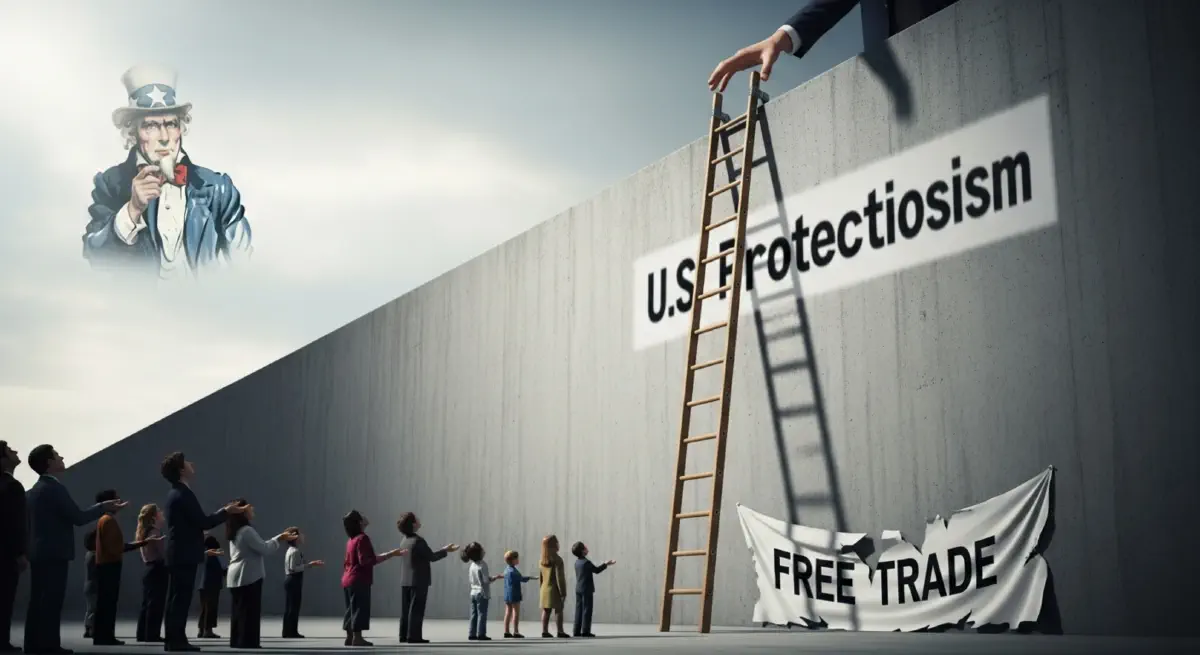
The United States lectures developing countries on free markets, open trade, and the evils of industrial policy. Yet the U.S. auto industry is one of the most protected, subsidized, and rent-ridden sectors in the world. The difference is that U.S. protectionism is often invisible: tariffs hidden as “national security,” bailouts disguised as “loans,” subsidies buried in defense appropriations.
Our series has argued that the narrow corridor to industrial success requires conditional, temporary, performance‑linked protection backed by strong institutions. The United States has none of these. It has unconditional, permanent, no‑performance protection with weak, politicized institutions.
If a developing country followed the U.S. model, it would fail. The U.S. has not failed yet, because it is rich, because it has a massive domestic market, because the dollar is the world’s reserve currency. These advantages have masked decades of policy failure.
But they will not mask it forever. China now leads in EV production and battery technology. The U.S. is falling behind. And the cause is not a lack of resources or talent. It is a lack of policy discipline, institutional capacity, and the political will to demand performance from its own firms.
This concludes Post 8 and the series. The United States is not a model for developing countries. It is a warning. The narrow corridor exists. But walking it requires more than resources. It requires policy discipline, institutional capacity, and the political will to demand performance from your own firms. Without those, even the richest country in the world falls behind.
End of series.