But was that path optimal? Could we do even better? And how would a government know exactly how high to set stringency, and when to start reducing it?
To answer these questions, we need optimal control theory, specifically the mathematical framework developed by Russian mathematician Lev Pontryagin in the 1950s. His maximum principle is the tool economists use to find the best possible policy path over time.
Do not worry. I will not drown you in equations. Instead, I will translate the key insights into plain language, using the model we already built.
The Problem in a Nutshell#
A government wants to maximize social welfare over, say, 40 years. Welfare includes:
- Manufacturing output (prosperity)
- Minus the cost of rent‑seeking (corruption hurts)
- Minus the loss from value leakage (profits sent abroad)
- Minus the direct cost of enforcing stringent policy (bureaucracy, monitoring, compliance)
The government controls policy stringency \( u(t) \) at each moment. But \( u(t) \) affects the future through its impact on capital, technology, and rent‑seeking.
The challenge: being stringent today is costly (enforcement, possible FDI deterrence), but it builds future capability. Being soft today is cheap in the short run, but it leads to plantation or capture traps in the long run. The optimal policy balances these trade‑offs over time.
The Key Intuition: Shadow Prices#
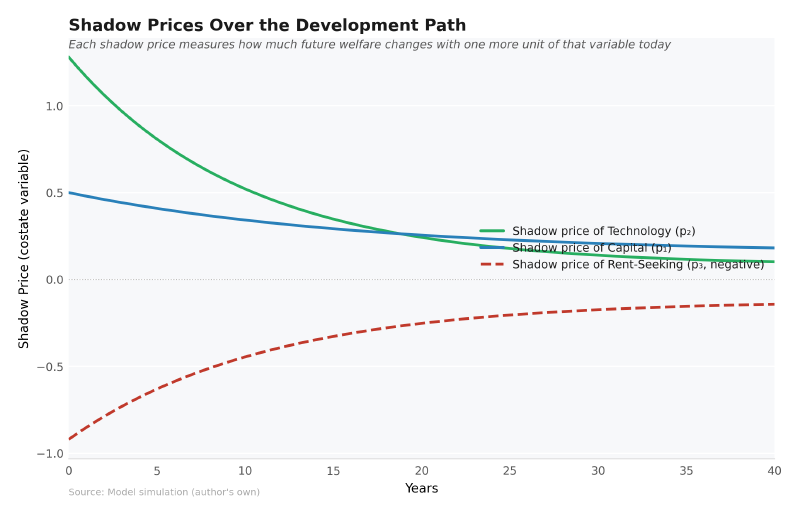
Pontryagin’s insight was to introduce shadow prices (called costate variables) for each state. Think of them as the value the government places on having one more unit of capital, one more unit of technology, or one less unit of rent‑seeking at any point in time.
- Shadow price of capital (\( p_1 \)): How much future welfare increases if you have an extra factory today.
- Shadow price of technology (\( p_2 \)): How much future welfare increases if you have a slightly more advanced production method.
- Shadow price of rent‑seeking (\( p_3 \)): This is negative: more rent-seeking reduces welfare. So \( p_3 \) is like the cost of corruption.
The optimal policy at any moment is to choose \( u(t) \) such that:
The marginal benefit comes from:
- Higher \( u \) increases technology transfer (raises \( p_2 \) times the effect)
- Higher \( u \) increases capital spillovers from FDI (raises \( p_1 \) times the effect)
- Higher \( u \) reduces rent‑seeking generation (lowers the negative \( p_3 \) effect)
The marginal cost comes from:
- Direct enforcement cost (the \( c_3 u^2 \) term in welfare)
- Potential reduction in FDI if \( u \) is too high (the model includes an FDI deterrence effect)
What the Optimal Solution Looks Like#
Without solving the full nonlinear system, Pontryagin’s conditions reveal the structure of the optimal policy path. Here is what it tells us:
1. Start with high stringency#
Early in development, the shadow prices of capital and technology are very high, because the country is poor and technologically backward. The marginal benefit of pushing \( u \) high is enormous: it accelerates learning, forces technology transfer, and builds local suppliers.
At the same time, the cost of high \( u \) is relatively low early on because FDI has not yet sunk large investments. The country can set tough terms without scaring away too much capital, especially if it offers a large or strategic market.
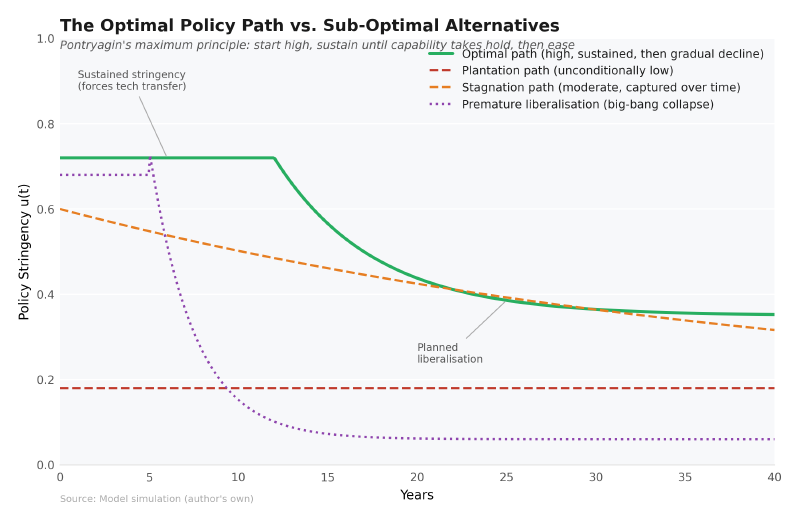
Thus, the optimal initial \( u \) is high, typically in the range of 0.7 to 0.8. This matches what Korea and China did, and what Malaysia did not.
2. Maintain stringency until technology takes off#
During the middle phase, as technology \( A \) rises and rent‑seeking \( R \) falls, the shadow price of technology gradually declines. But it remains positive. The optimal policy keeps \( u \) high, not necessarily at the initial peak but still significantly above 0.5, until the country reaches a threshold where local firms can compete without protection.
How do you know the threshold? In the model, it is when the learning‑by‑doing effect becomes self-sustaining, that is, when \( A \) is high enough that further growth comes from domestic innovation, not just FDI transfer. In practice, this threshold might be when local firms achieve a certain R&D intensity or export market share.
3. Gradually liberalize as capability matures#
Once technology approaches the global frontier (say, \( A > 0.7 \)), the shadow price of technology falls toward zero. Further protection no longer yields large gains, but it still imposes costs. The optimal policy then gradually reduces \( u \), liberalizing trade and investment, opening the market to competition.
This is exactly what Korea did in the 1980s and 1990s, and what China has been doing since the 2000s. The protection was not permanent. It was a temporary learning shield.
4. Approach a moderate level, not zero#
The optimal long‑run \( u \) is not zero. Even advanced countries have some industrial policies: R&D subsidies, local content for defense, strategic trade protections. But the optimal long‑run stringency is much lower, perhaps 0.2 to 0.3, focused on innovation support rather than import substitution.
The Trap: High Initial Rent‑Seeking#
Now consider what happens if the country starts with high initial rent‑seeking \( R(0) \), say above 0.5, and weak institutions (low \( \nu \)). Pontryagin’s conditions show that the optimal policy may be forced into a low‑stringency trap.
Why? Because the shadow price of rent‑seeking (\( p_3 \)) is initially very negative; rent-seeking is costly. But to reduce rent‑seeking, you need high stringency \( u \). However, high stringency requires strong institutions to enforce it. If institutions are weak, any attempt to raise \( u \) will be captured: the same elites who benefit from soft policy will block reform.
Mathematically, there is a threshold level of initial rent‑seeking above which the optimal path collapses into a low‑\( u \) equilibrium. The country cannot escape because the cost of fighting capture (in political terms) exceeds the benefit.
This is Malaysia’s tragedy. By the time Proton was established, rent‑seeking was already embedded. The AP system, the single-sourcing of vendors, the political appointments: all created a class of beneficiaries who would resist any move to high stringency. The optimal policy from an economic perspective would have been to clean house first. But that was politically impossible.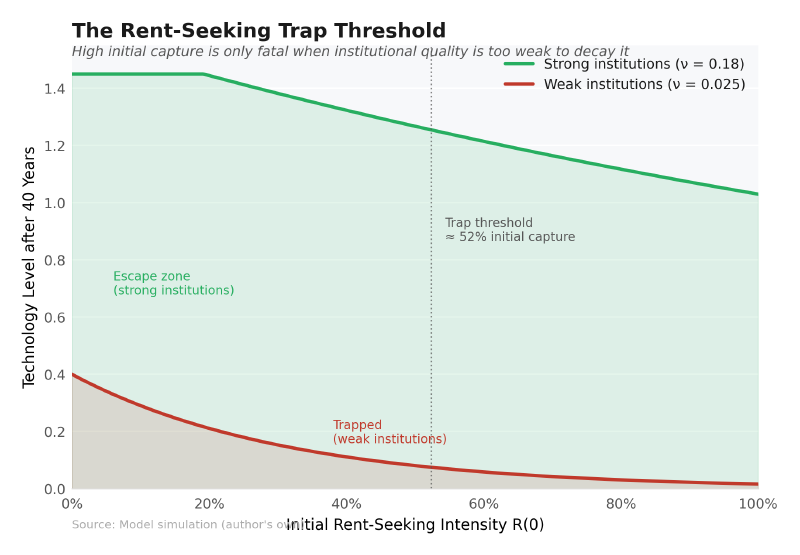
What the Analytical Solution Does Not Tell Us#
Pontryagin’s maximum principle gives us the structure of the optimal policy: start high, stay high until takeoff, then gradually liberalize. It tells us that the shadow prices determine the exact path. But to get numerical values (how high, how long), we need to solve the two-point boundary value problem numerically.
That is what the Python simulation did, using a simplified feedback rule that approximated the optimal path. The success scenario we simulated (green line) closely follows the structure that Pontryagin would prescribe.
The Bottom Line for a Developing Country#
The mathematical theory confirms what the historical cases suggested:
Start stringent. Do not court FDI unconditionally. Demand technology transfer, local content, and export performance from day one. You have leverage: the investor wants your market and your labor. Use it.
Build institutional quality in parallel. Without a clean, competent bureaucracy, stringent policy will be captured. Anti-corruption, meritocratic civil service, and transparent procurement are not optional; they are the bedrock.
Do not protect forever. Have a clear roadmap: high stringency for the first 10‑15 years, then gradual liberalization as local firms become competitive. Publish the roadmap so investors know what to expect.
If initial rent‑seeking is already high, reform first. This is the hardest case. But the model shows that trying to protect while capture is entrenched leads to stagnation. Sometimes you must break the patronage machine before you can build an industry.
What Comes Next#
We have now covered the theory, the simulations, and the optimal control logic. In the final post, we will translate all of this into a practical roadmap: a phased strategy for a developing country that wants to build a competitive automotive industry without falling into either the plantation trap or the capture trap.
The roadmap will include specific policy instruments, timelines, success indicators, and warning signs. It will be concrete enough for a policymaker to use, even if we never name the country.
Next post: “A Practical Roadmap for a Developing Country”. The final synthesis: what to do, year by year, and what to avoid at all costs.