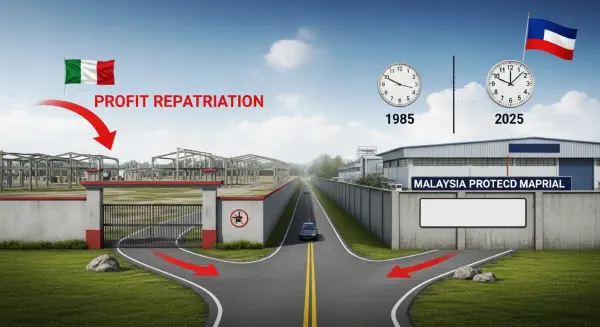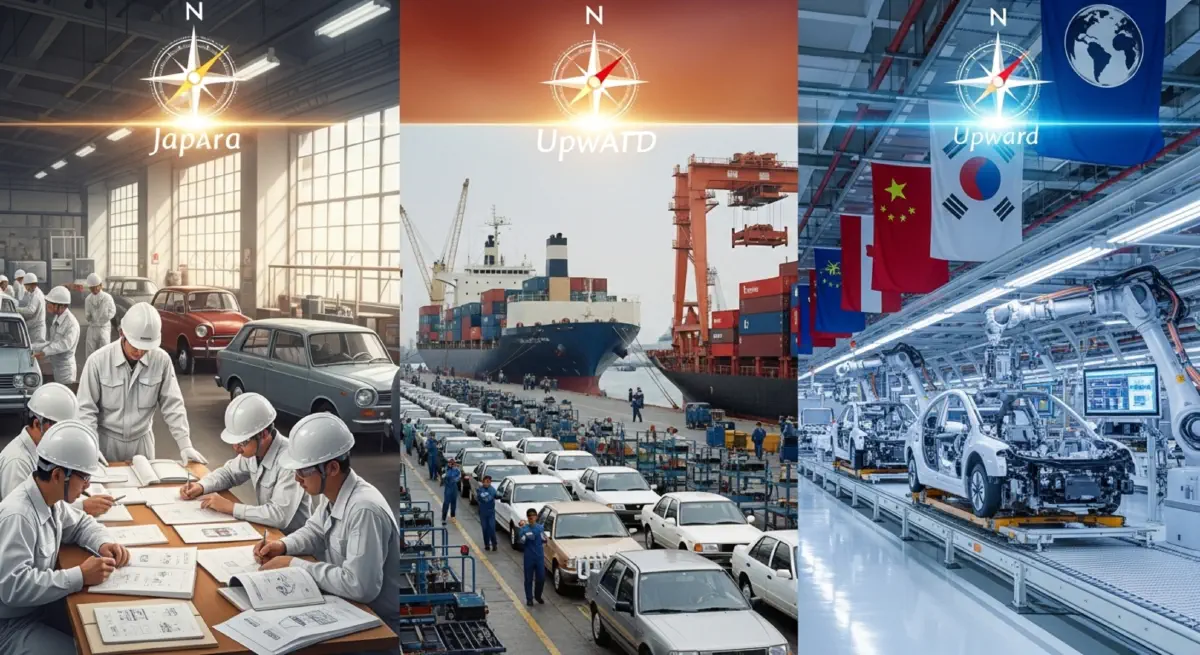
But there is a third path. It is narrow, difficult, and demands exceptional institutional discipline. Yet it has been walked successfully by Japan, South Korea, and more recently China.
These countries did not reject FDI or protection. They used both, but on their own terms. They turned foreign capital and temporary shielding into genuine technological capability, globally competitive firms, and rising living standards.
How did they do it?
The Common Playbook#
Despite their differences in size, culture, and political systems, Japan, Korea, and China followed a remarkably similar industrial strategy. Let me distill it into six core principles.
1. Protection was temporary and conditional#
In the 1960s and 1970s, Japan’s MITI protected the domestic auto market from foreign imports. But the protection came with a clock. Firms knew that tariffs would eventually fall. More importantly, protection was conditional on performance.
Korea’s Park Chung-hee regime gave Hyundai and Kia access to subsidized credit, import licenses, and tariff walls. But the chaebols had to meet export targets. If you wanted to sell cars in Seoul, you had to sell them in Cairo, Quito, or Vancouver first.
China, from the 1980s onward, required foreign automakers to form 50:50 joint ventures with local partners. Access to the world’s largest potential market was granted only in exchange for technology transfer, local R&D, and export commitments.
Contrast with Malaysia: Proton received protection for decades with no export mandates, no technology transfer milestones, and no sunset clause.
2. Technology transfer was demanded, not hoped for#
Japan began by licensing technology from European and American firms (Nissan under Austin, Isuzu under GM). But licensing agreements included clauses that allowed Japanese engineers to reverse-engineer and improve upon the designs. Within a decade, Nissan and Toyota were designing their own engines.
Korea’s Hyundai initially assembled Ford Cortinas. But when it launched its own car, the Pony, it demanded that its British and Japanese partners provide not just parts, but full engineering training for Korean staff. The partnership was structured as a learning contract, not a production contract.
China’s joint venture rules required foreign partners to establish R&D centers in China, transfer intellectual property for localized models, and train Chinese engineers. Foreign firms complained, but they complied, because the market was too large to ignore.
Malaysia’s deal with Mitsubishi had no such teeth. Mitsubishi supplied outdated platforms, resisted technology transfer, and blocked Proton’s exports. Malaysia had no leverage because it offered only a small market and had no alternative partner.
3. Domestic competition was enforced#
Japan had multiple firms: Toyota, Nissan, Honda, Mazda, Mitsubishi, Subaru, Suzuki. MITI deliberately encouraged rivalry. Firms that fell behind were not bailed out; they were merged or left to struggle.
Korea had fewer chaebols (Hyundai, Daewoo, Kia, SsangYong), but the state played them against each other. Subsidies were allocated based on export performance. Underperformers lost access to credit.
China licensed dozens of auto firms initially, creating a crowded, chaotic market. Over time, the strongest (Geely, BYD, Chery, Great Wall, SAIC) emerged, while weak firms were consolidated or closed. Foreign JVs competed fiercely with each other and with local brands.
Malaysia had Proton as a near-monopoly. Perodua came later but targeted a different segment. There was no real rivalry, no pressure to innovate, and no mechanism to replace failing management.
4. Bureaucracy was autonomous and meritocratic#
Japan’s MITI was staffed by elite technocrats recruited from the top universities. They were insulated from political pressure and could make long-term plans without fear of electoral cycles. They also had the authority to discipline firms.
Korea’s Economic Planning Board (EPB) operated similarly. It was a “super-ministry” that controlled the national budget, credit allocation, and industrial policy. EPB officials were career civil servants, not political appointees.
China’s system is different; the Communist Party maintains tight control, but economic planning agencies (NDRC, MIIT) are staffed by technically trained cadres who rise through merit. Policy is debated internally, but once decided, it is implemented with formidable consistency.
Malaysia’s bureaucracy, by contrast, became politicized. The Economic Planning Unit (EPU) and MITI lost autonomy. Politicians, not technocrats, made the key decisions, especially regarding Proton. Bureaucrats became implementers of political will, not strategic planners.
5. Rent-seeking was suppressed, not nurtured#
All fast-growing economies have corruption. But Japan, Korea, and China managed to channel rent-seeking toward productive ends, or at least prevent it from destroying industrial policy.
In Korea, chaebols received massive subsidies and preferential loans. But the state also demanded performance. Firms that failed were cut off. Rent was a tool, not an end in itself.
In Japan, the famous “convoy system” protected weak firms, but MITI also pushed restructuring. Political connections could help, but they could not substitute for competitiveness.
In China, local protectionism and cronyism are real problems. But the central government also launches anti-corruption campaigns, and firms that cannot compete, even politically connected ones, are allowed to fail.
Malaysia’s AP system is the opposite: a pure rent-seeking machine with no productive purpose. Politically connected individuals collected permits and sold them for profit, contributing nothing to industrial capability. The system became politically impossible to remove because it financed the ruling coalition.
6. The ultimate goal was always export competitiveness#
Japan, Korea, and China never treated their domestic markets as the final destination. The domestic market was a training ground for global competition.
Japan pushed Toyota and Nissan into the US market in the 1970s despite quality problems. The pressure of American consumers forced continuous improvement.
Korea forced Hyundai to export to Canada and the US before its cars were ready. Early models were terrible. But the humiliation drove the company to invest in quality.
China’s auto exports took longer, but by 2023, China became the world’s largest auto exporter, led by EVs from BYD, Geely, and Chery.
Malaysia’s Proton never seriously pursued exports. When it tried, it failed and retreated to the protected domestic market. The absence of export discipline meant no pressure to improve.
The Institutional Secret#
What unites these six principles is not a specific policy tool. It is institutional capacity: the ability of the state to design and enforce conditional policies without being captured by private interests.
Japan had MITI. Korea had EPB. China has a Leninist party-state that can override local interests. All three built autonomous, competent, and disciplined economic bureaucracies.
Malaysia, despite having formal planning agencies, allowed political elites to override technocratic judgment. The result: protection became permanent, rent-seeking became endemic, and the national car became a symbol of stagnation, not progress.
The Narrow Corridor#
The East Asian experience shows that there is a narrow corridor between the plantation trap and the capture trap.
- Too open, too passive → Mexico.
- Too protected, too captured → Malaysia.
- Conditional, temporary, performance-linked protection with strong institutions → Japan, Korea, China.
In the next post, we will translate these insights into a mathematical model, because intuition alone is not enough to guide policy. We need to know how much protection, for how long, and under what conditions.
But before we get to equations, remember this: the East Asian miracle was not magic. It was engineered by governments that understood one simple truth:
Next post: A Mathematical Model of Industrial Catch-Up. We will build a dynamic system that captures capital, technology, rent-seeking, and policy, then simulate the three paths.