It sounds compelling. And in some places, it has worked, at least for a while.
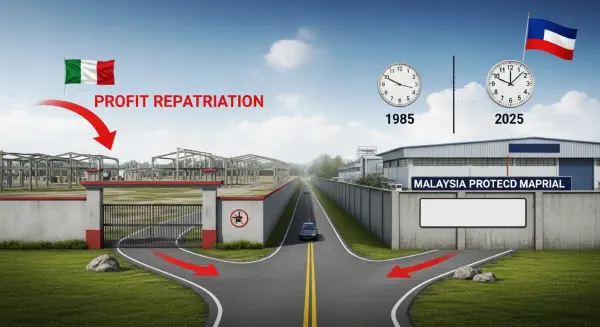
But there is a darker, quieter story. A story where FDI does not build industries, but instead creates a modern plantation: an enclave of foreign-owned assembly plants that extract cheap labor, consume tax breaks, and repatriate profits, leaving behind little more than low wages and a hollowed-out industrial base.
This is not a metaphor. It is a structural reality.
The Maquiladora Warning#
Mexico’s maquiladora program is the classic example. Since the 1960s, hundreds of foreign factories, mostly US-owned, have operated along the border, importing components duty-free, assembling them into finished goods, and exporting them back north. The policy succeeded in creating jobs. Millions of Mexicans found work.
But look deeper. Only about 18% of the export value stays in Mexico. The rest flows out as imported components, royalties, management fees, and repatriated profits. An estimated $15 billion or more leaves the country every year. Local suppliers are weak because foreign firms prefer their own trusted networks. Technology transfer is minimal: workers learn to operate a machine, not to design or improve it.
Mexico became an assembly platform, not an industrial nation. When global supply chains shift (to Vietnam, to China, to automation), the factories can leave overnight. The plantation does not fight back.
The Anatomy of a Modern Plantation#
What turns FDI into a modern plantation? Four features stand out:
Foreign ownership dominates: Local firms never get a foothold in high-value activities like design, R&D, or strategic management.
Weak backward linkages: The supply chain is imported, not local. Multipliers are tiny.
Profit repatriation is massive: Earnings flow to headquarters abroad, not reinvested locally.
Policy is passive: The host country offers tax holidays, cheap land, and weak labor protections, but demands nothing in return.
This is not a conspiracy. It is a rational outcome of global capitalism. Multinational corporations exist to maximize shareholder value, not to develop host countries. If a country offers a cheap, docile, disposable platform, they will take it. They give nothing back unless forced.
The Counterexample: East Asia#
Now compare Mexico to South Korea or Taiwan in the 1970s and 1980s. Those countries also attracted FDI. But they did so on their own terms.
They demanded:
- Joint ventures with local majority ownership
- Technology transfer agreements with clear milestones
- Local content requirements that built domestic supply chains
- Export performance targets (you want access to our market? Then you must sell abroad from here)
- And crucially, they built autonomous, meritocratic bureaucracies (Korea’s EPB, Japan’s MITI) to enforce these rules without political capture.
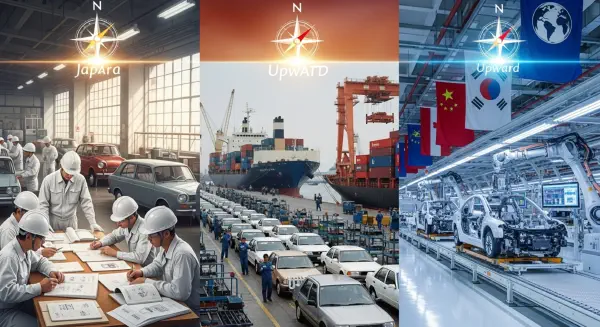
The result? South Korea’s Hyundai and Kia, Taiwan’s electronics giants, Japan’s Toyota: all started with conditional, strategic FDI, then grew into globally competitive firms. The plantation became a workshop, then a design house, then an innovator.
The Question This Series Will Answer#
So here is the central question for any developing country today:
How can you attract FDI without becoming a modern plantation? How can you use foreign capital to build your own technological and industrial capabilities, not just assembly lines?
And equally important: how do you avoid the other trap, the Malaysia trap, where protection becomes permanent, political patronage saps efficiency, and the national champion becomes a national burden?
Over the next seven posts, we will explore these questions using:
- Historical case studies (Japan, Korea, China, Malaysia, Mexico)
- A mathematical model of industrial catch-up
- Optimal control theory (yes, with equations, explained intuitively)
- A practical roadmap for a developing country that wants to succeed where many have failed.
- A final case study on the richest, most powerful country in the world, to show how even the US is not immune to these dynamics.
But before we go there, let’s sit with this uncomfortable truth:
Next post: “Two Paths to Stagnation – What Malaysia and Mexico Teach Us”. We will contrast the captured protectionism of Malaysia with the open-door plantation of Mexico, and show how both lead to a middle-income trap.