
How to Build an Automotive Industry: Lessons from Malaysia, Mexico, and East Asia
A Practical Framework for Industrial Catch‑Up#
Across the developing world, governments share a common ambition: to build a globally competitive automotive industry. The promise is immense – thousands of high‑quality jobs, deep industrial linkages, technological spillovers, and a pathway to high‑income status. Yet for every country that has succeeded, many more have failed. Worse, they have failed in systematic, predictable ways.
This eight‑post series distils decades of industrial policy experience into a rigorous, practical framework. It is grounded in a detailed case study of Malaysia’s national car project (Proton) as documented by Firdausi Suffian (2021), extended through comparative analysis of Mexico’s maquiladora model, Japan’s MITI‑led miracle, South Korea’s chaebol‑driven catch‑up, and China’s joint‑venture strategy. Drawing on developmental state theory and new institutional economics, the series:
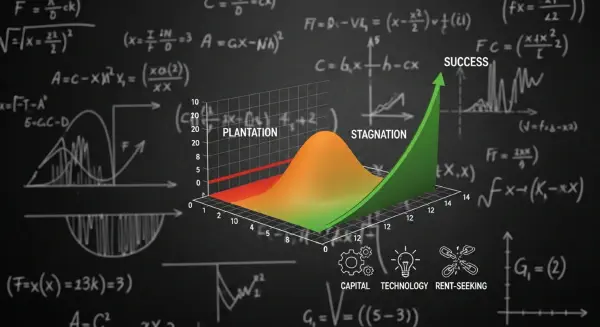
- Builds a mathematical model of industrial catch‑up with five state variables (capital, technology, rent‑seeking, value retention, export competitiveness) and one policy control (stringency).
- Simulates three archetypal trajectories (plantation, stagnation, success) over 40 years.
- Derives the optimal policy path using Pontryagin’s maximum principle.
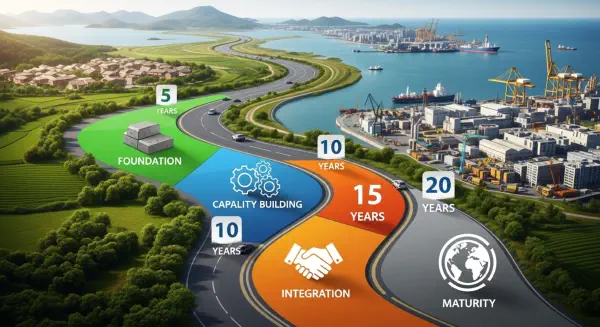
- Concludes with a year‑by‑year roadmap for a developing country seeking to navigate the narrow corridor between the plantation trap and the capture trap.
- Adds a critical eighth post on the United States – a rich country that preaches free trade while practicing protectionism, revealing the hypocrisy of “kicking away the ladder.”
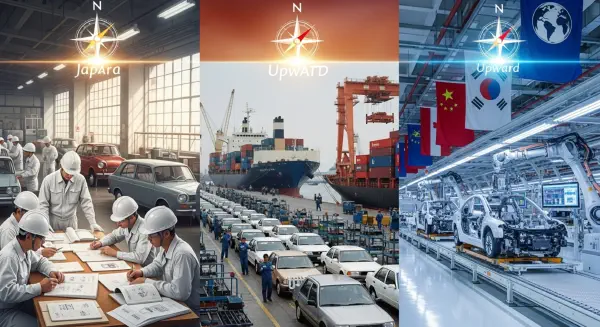
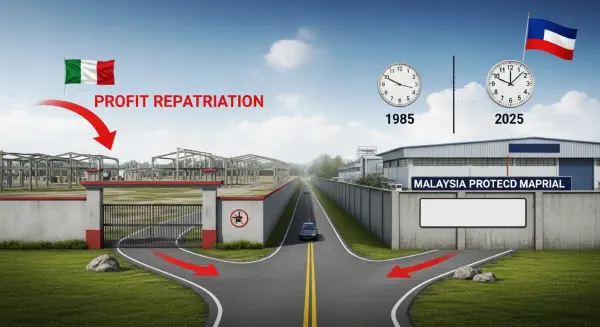
The core argument is simple but radical: unconditional protection leads to rent‑seeking and stagnation (Malaysia). Unconditional openness leads to low‑value enclaves and profit repatriation (Mexico). The only way to succeed is to pursue conditional, temporary, performance‑linked protection backed by strong institutional capacity – precisely the strategy that Japan, Korea, and China employed.
References#
Amsden, A. H. (1989). Asia’s next giant: South Korea and late industrialization. Oxford University Press.
https://opac.unu.edu/cgi-bin/koha/opac-detail.pl?biblionumber=135Berry, S., Levinsohn, J., & Pakes, A. (1999). Voluntary export restraints on automobiles. PERC.
https://www.perc.org/1999/09/01/voluntary-export-restraints-on-automobiles/Bhattacharya, P., & Hutchinson, F. E. (2024). Shifting to a higher gear: The saga of Malaysia’s national carmaker Proton. ISEAS – Yusof Ishak Institute.
https://bookshop.iseas.edu.sg/publication/7897Business Insider. (2020). Milton Friedman’s shareholder primacy doctrine.
https://www.businessinsider.com/milton-friedmans-theory-role-of-business-feels-emptier-than-ever-2020-9Chen, Y., Dai, X., Fu, P., Luo, G., & Shi, P. (2024). A review of China’s automotive industry policy: Recent developments and future trends. Journal of Traffic and Transportation Engineering (English Edition), 11(5), 867-895.
https://doi.org/10.1016/j.jtte.2024.09.001CSIS (Center for Strategic and International Studies). (2025). What’s missing in the US debate on electric vehicles.
https://www.csis.org/analysis/whats-missing-us-debate-electric-vehiclesDowie, M. (1977). Pinto madness. Mother Jones.
https://motherjones.com/politics/1977/09/pinto-madness/Evans, P. B. (1995). Embedded autonomy: States and industrial transformation. Princeton University Press.
https://opac.unu.edu/cgi-bin/koha/opac-detail.pl?biblionumber=1433EY. (2025). Final reconciliation legislation modifies IRA energy credits.
https://taxnews.ey.com/news/2025-1434-final-reconciliation-legislation-modifies-some-ira-energy-credits-repeals-othersGallagher, K. P., & Zarsky, L. (2007). The enclave economy: Foreign investment and sustainable development in Mexico’s Silicon Valley. MIT Press.
https://doi.org/10.7551/mitpress/7466.001.0001GovTrack. (1979). Chrysler Corporation Loan Guarantee Act of 1979.
https://www.govtrack.us/congress/bills/96/s2094/summaryJohnson, C. (1982). MITI and the Japanese miracle: The growth of industrial policy, 1925–1975. Stanford University Press.
https://www.degruyter.com/document/doi/10.1515/9780804765602/htmlKamien, M. I., & Schwartz, N. L. (1991). Dynamic optimization: The calculus of variations and optimal control in economics and management (2nd ed.). North‑Holland. (No URL – print book)
Nader, R. (1987). Energy conservation.
https://nader.org/1987/08/20/energy-conservation/New York Times. (2024). How Trump could upend electric car sales.
https://www.nytimes.com/2024/11/25/business/trump-electric-vehicle-tax-credit.htmlWijnen, W., Dahdah, S., & Pkhikidze, N. (2026). The value of a statistical life in the context of road safety: a new value transfer approach. Traffic Injury Prevention, 27(1), 42–49. https://doi.org/10.1080/15389588.2025.2476607
Pontryagin, L. S., Boltyanskii, V. G., Gamkrelidze, R. V., & Mishchenko, E. F. (1986). The mathematical theory of optimal processes. CRC Press. https://api.pageplace.de/preview/DT0400.9781351433075_A37629368/preview-9781351433075_A37629368.pdf
Rodrik, Dani. “Industrial Policy for the Twenty-First Century.” KSG Faculty Research Working Paper Series RWP04-047, November 2004. https://www.hks.harvard.edu/publications/industrial-policy-twenty-first-century#citation
Suffian, F. (2021). Political economy of Malaysia’s industrial policy: Institutional capacity and the automotive industry. Springer.
https://doi.org/10.1007/978-981-33-6901-6Toyota Global. (n.d.). Voluntary restraints imposed on exports to U.S.
http://www.toyota-global.com/company/history_of_toyota/75years/text/leaping_forward_as_a_global_corporation/chapter1/section1/item2.htmlUPI. (1985). Japan to maintain car export restrictions.
https://www.upi.com/Archives/1985/03/27/Japan-to-maintain-car-export-restrictions/8377480747600Virtanen, P., Gommers, R., Oliphant, T. E., et al. (2020). SciPy 1.0: Fundamental algorithms for scientific computing in Python. Nature Methods, 17, 261–272.
https://doi.org/10.1038/s41592-019-0686-2Wad, P., & Govindaraju, V. G. R. C. (2011). Automotive industry in Malaysia: An assessment of its development. International Journal of Automotive Technology and Management, 11(2), 152-171.
https://doi.org/10.1504/IJATM.2011.039542Wade, R. (1990). Governing the market: Economic theory and the role of government in East Asian industrialization. Princeton University Press.
https://opac.unu.edu/cgi-bin/koha/opac-ISBDdetail.pl?biblionumber=5542Wang, H. (2017–2020). Technological innovation and institutional transformation: The Chinese automotive industry and regional development. City University of Hong Kong.
https://scholars.cityu.edu.hk/en/projects/technological-innovation-and-institutional-transformation-the-chiWang, H., & Zhu, L. (2025). Technological innovation, industrial structure upgrading, and the coordinated development of regional economies. Sustainability, 17(17), 7880.
https://doi.org/10.3390/su17177880Whitfield, L., & Wuttke, T. (2025). The political economy of industrial policy in Malaysia: Lessons from the automotive sector. Journal of Development Studies, 61(3), 456-475.
https://doi.org/10.1016/j.peg.2025.100054Wikipedia. (1979). Chrysler Corporation Loan Guarantee Act.
https://en.wikipedia.org/wiki/Chrysler_Corporation_Loan_Guarantee_Act_of_1979Wikipedia contributors. (2026, February 26). Who Killed the Electric Car?. https://en.wikipedia.org/w/index.php?title=Who_Killed_the_Electric_Car%3F&oldid=1340506443