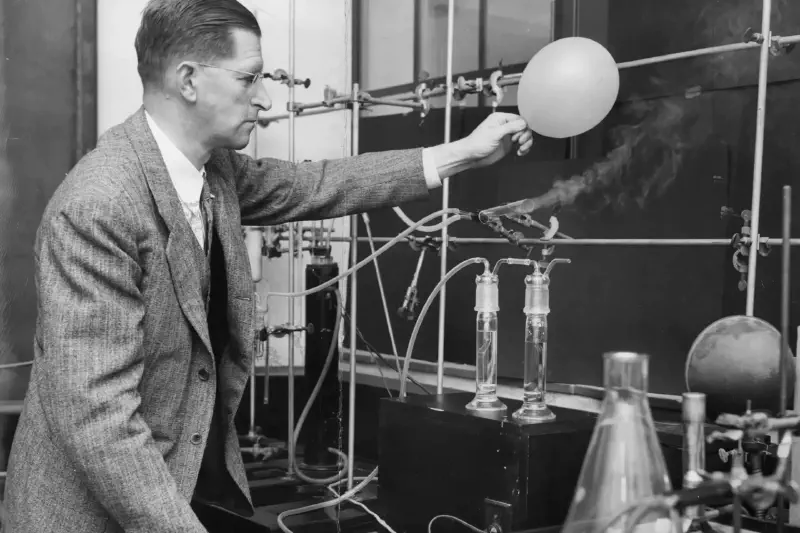
In 1921, Thomas Midgley Jr., working under the direction of Charles Kettering at General Motors Research, poured a small quantity of tetraethyl lead into a knocking test engine. The silence that followed was not merely mechanical; it was the quiet of a trillion-dollar industry finding its permanent fuel. For years, the internal combustion engine had been limited by "knock"—the premature, violent detonation of fuel that shattered pistons and limited compression ratios. The solution was obvious to any chemist: higher octane. But octane was expensive to refine, and ethanol—a perfect anti-knock agent—could be grown by any farmer. Ethanol could not be patented. Tetraethyl lead, however, was a proprietary chemical that General Motors and Standard Oil could own. They called it "Ethyl," a soft, feminine name designed to mask the fact that the additive was a neurotoxin. When Midgley himself fell ill with lead poisoning and was forced to take a "vacation" in Florida to recover, the company line remained unchanged. Lead was not a hazard; it was progress.
The marketing of lead was the first great act of institutional gaslighting in the automotive age. It allowed the petrol engine to become more powerful and more "efficient" without requiring any fundamental change to its architecture. It was the ultimate "Sailing Ship" maneuver: rather than moving to a superior propulsion system, the industry poisoned the air to make a flawed one work better. By the 1950s, the "leaded" car was the global standard, and the atmosphere of every major city was being seeded with a heavy metal that lowers IQ and increases aggression. This was not a scandal. It was a business model.
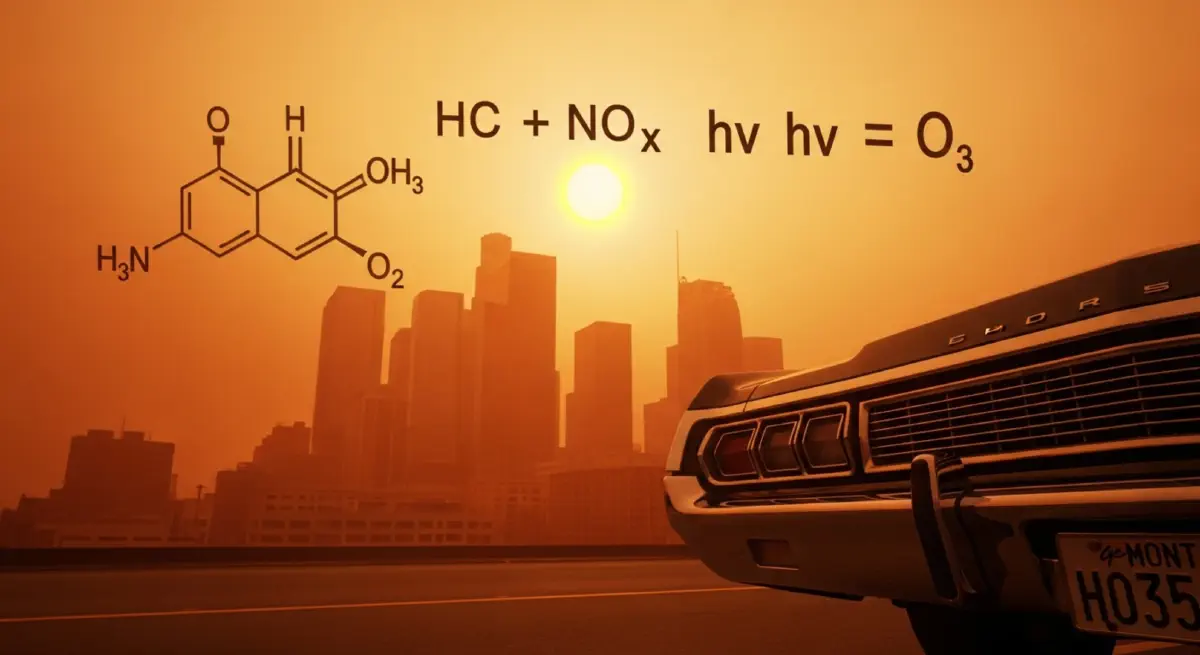
In 1943, the residents of Los Angeles began to notice a thick, yellowish-brown haze that stung the eyes and scorched the lungs. They called it "smog." At first, the city blamed the synthetic rubber plants and the trash incinerators. The automotive industry, represented by the Society of Automotive Engineers, maintained a posture of "selective blindness." They argued that the car was a "clean" machine and that any smoke was the result of poor maintenance by the user. It took a Dutch chemist at Caltech, Arie Jan Haagen-Smit, to prove otherwise. In 1952, he demonstrated that the combination of unburned hydrocarbons and nitrogen oxides—the precise waste products of the internal combustion engine—reacted with sunlight to create ozone and peroxyacetyl nitrate. The car was not just a vehicle; it was a mobile chemical factory.
The industry's response to Haagen-Smit was a masterpiece of "scientification" as a defensive strategy. They did not deny the chemistry; they questioned the "significance." They demanded more studies, more data, and more time. This period of "normal change" was characterized by a frantic attempt to find a "technological fix" that would satisfy regulators without requiring the industry to abandon the petrol engine. This led to the "Clean Air Act" of 1970 and its 1976 amendments—the most significant "technology-forcing" legislation in history.
The U.S. government effectively told the car companies: "Reduce emissions by 90%, or you cannot sell cars." This was a direct threat to the "locked-in" technical regime. The industry fought back with the "Pluto Effect." They claimed that such targets were physically impossible, that they would bankrupt the economy, and that the "average motorist" would never accept the loss of performance. Then, they did what they always do: they added complexity to mask the flaw.
The result was the "Catalytic Converter." Introduced in 1975, the catalyst is a device that sits in the exhaust stream and uses precious metals like platinum and palladium to "scrub" the gases. It is a brilliant piece of engineering that allows the engine to remain a dirty, 19th-century explosion cycle while the tailpipe emits (mostly) harmless water vapor and CO2. But the catalyst came with a catch: it is poisoned by lead. To save the air from smog, the industry was finally forced to give up the lead that Kettering had sold them fifty years earlier. The "unleaded" car was not a choice; it was a surrender to the physical limits of the atmosphere.
In Europe, the reaction was different. European engineers, led by companies like Volkswagen and Peugeot, resisted the catalyst for as long as possible. They argued for the "Lean Burn" engine—a system that would be inherently clean by using less fuel and more air. They saw the catalyst as an "American" solution—heavy, expensive, and wasteful. This led to the "Dieselization" of the European fleet. Diesel engines were sold as the "environmental" choice because they produced less CO2. The industry ignored the fact that they produced massive amounts of particulate matter and nitrogen oxides. They "scientified" the diesel engine with turbochargers and high-pressure common-rail injection, creating the "clean diesel" myth that would eventually collapse in the "Dieselgate" scandal of 2015.
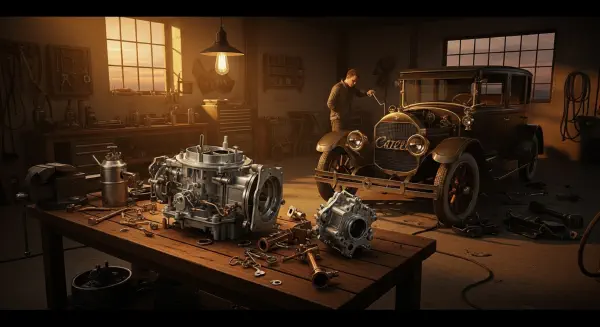
The "Electronic Revolution" was the final layer of mediation. To make the catalyst work, the engine had to be controlled with a precision that no mechanical carburetor could achieve. The industry had to replace the "mechanical feel" of the engine with an "Electronic Control Unit" (ECU). The car became a computer that happened to be attached to a pump. This was the ultimate deskilling of the technician. You could no longer fix a car with a wrench; you needed a proprietary diagnostic tool to "talk" to the ECU.
This is the state of the modern car: a machine so complex that it requires a microprocessor to keep its own waste products from killing its operator. We have spent half a century and trillions of dollars perfecting the "after-treatment" of a fuel that we should have abandoned in 1921. We have built a global infrastructure around a "path-dependent" mistake. The institutions—the car companies, the oil companies, the regulatory agencies—all have a vested interest in the "incremental" improvement of the status quo. They call it "decarbonization," but it is just the latest version of the Sailing Ship Effect.
The car is a parasite on its own environment. It requires the paving of the earth, the poisoning of the air, and the extraction of every last drop of fossilized sun. We have "scientified" our way into a corner where the only way forward is to stop moving in the same way. But as long as the "Pluto Effect" holds—as long as we demand the "private cocoon" and the "unlimited range"—the industry will continue to sell us the next "technological fix."