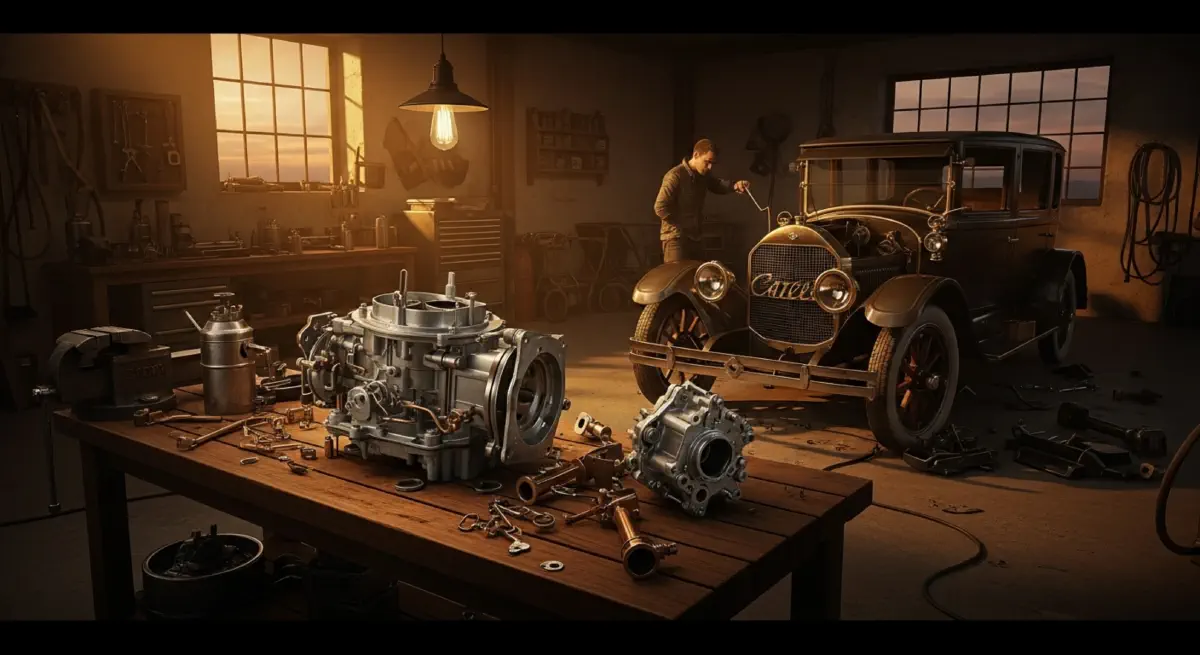
In 1912, the engineers at Cadillac faced a problem of basic physics that they chose to solve with a marketing myth. They needed to replace the hand-crank, a device responsible for more broken wrists and back injuries than almost any other mechanical interface of the era, with an electric starter. The industry consensus, backed by the leading electrical theorists of the day, held that a motor capable of turning over a cold internal combustion engine would require at least 5 hp (~3.7 kW) of power. This was a death sentence for the electric starter; a 5 hp (~3.7 kW) motor, along with the lead-acid batteries required to feed it, would have weighed as much as a small piano and occupied half the chassis. Charles Kettering, a man less burdened by the "laws" of electrical engineering than by the commercial imperatives of General Motors, realized that the theorists were calculating for a continuous load. An engine does not need to be turned forever; it only needs to be jerked into life. Kettering designed a motor that could briefly output the necessary torque by running at a massive over-voltage, counting on the fact that the motor would stop before it melted. This was not an elegant solution. It was a technical hack that allowed a fundamentally temperamental, vibrating, and loud propulsion system—the internal combustion engine—to simulate the effortless operation of the electric vehicle.
We are taught that the petrol car won because it was superior. This is the first lie of the automotive handbook. In the opening decade of the 20th century, the petrol engine was the least likely candidate for global dominance. It was a German invention that required French refinement to become even remotely reliable, and even then, it was a "German invention in France" that existed in a chaotic variety of setups. You could find engines in the front, in the rear, or under the seat. Passengers sat facing each other in "vis-à-vis" arrangements or staring at the back of the driver’s head in a "dos-à-dos" configuration. The electric vehicle was silent, clean, and required no gear-shifting. The steam car offered massive torque and a level of mechanical simplicity that the petrol engine, with its hundreds of moving parts, could never hope to match. Yet, the petrol engine is what we have. It did not win because it was better at being a tool of transport; it won because it was better at being a tool of adventure.
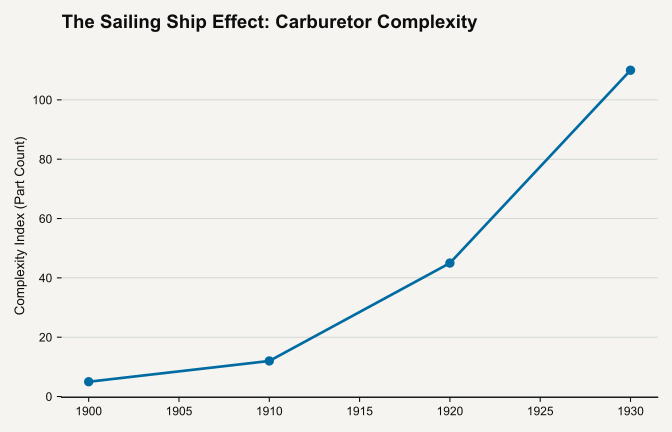
The victory of the petrol engine is an example of what historians of technology call the "Sailing Ship Effect." When a new, superior technology appears on the horizon—like the steamship or the electric car—the proponents of the old technology do not simply surrender. They begin a frantic, late-stage refinement of their failing system. They add complexity to mask inherent flaws. They squeeze every possible ounce of efficiency out of a design that has reached its logical limit. The carburetor is the perfect monument to this desperation. It began as a simple device to mix air and fuel. As the internal combustion engine was pushed to higher speeds and varying altitudes to satisfy the "sophisticated motorist," the carburetor became a nightmare of jets, needles, and diaphragms. It was a technology "hurting at a technological limit".
The Sailing Ship Effect: Carburetor complexity as a response to the threat of alternative propulsion systems.
The "Pluto Effect" describes this drift. Named after the Disney dog whose legs often move faster than his body, it refers to the phenomenon where a technology is "dragged" along by the changing habits and practices of its users. The early motorists were not looking for a reliable way to get to work. They were wealthy adventurers looking for a way to "tour." They wanted to go far, into the countryside, where there were no charging stations for electric cars and no high-pressure water for steam boilers. They were willing to tolerate the grease, the noise, and the constant mechanical failure of the petrol engine because it offered the promise of unlimited range—provided you carried enough cans of fuel. The car became "social" before it became "functional". It was an instrument of class identity, a way to signal that you had the time and the money to waste on a machine that required a professional "chauffeur" just to keep it running for a single afternoon.
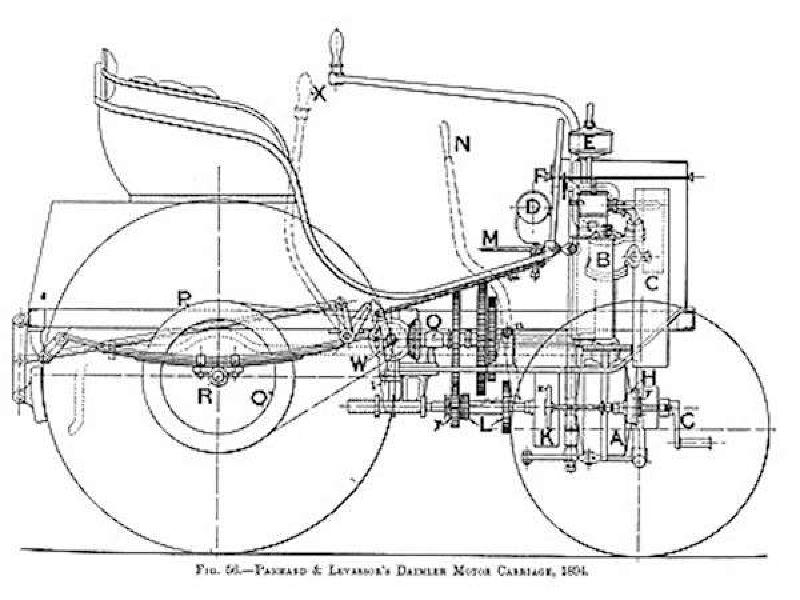
The architecture of this victory was the "Panhard System." Developed by Panhard & Levassor in France, it placed the engine in the front, followed by a clutch, a gearbox, and a drive shaft leading to the rear wheels. This layout was not chosen for its efficiency. It was chosen because it provided the best cooling for the temperamental petrol engine and allowed for a heavy, durable chassis that could survive the unpaved roads of the 1900s. It became the "standard" not through engineering consensus, but through a process of "normal change" where the industry simply stopped looking for alternatives. By the time the Bosch high-tension magneto solved the problem of unreliable ignition, the Panhard system was so entrenched that the electric car was relegated to a niche for "city use".
T1894 Panhard et Levassor – Science Museum UK.
Consider the clutch. The early cone clutch was a brutal device. It used a leather-faced cone that was shoved into the flywheel. If it was too dry, it "grabbed" and jerked the car forward; if it was too oily, it slipped and smelled of burnt leather. Engineering did not solve this by moving to a better propulsion system. It solved it by inventing the multi-plate disc clutch and the diaphragm spring, a system where the force required to declutch actually decreased after reaching a maximum. We added more layers of mechanical mediation to hide the fact that the engine itself was a violent, reciprocating mess of explosions.
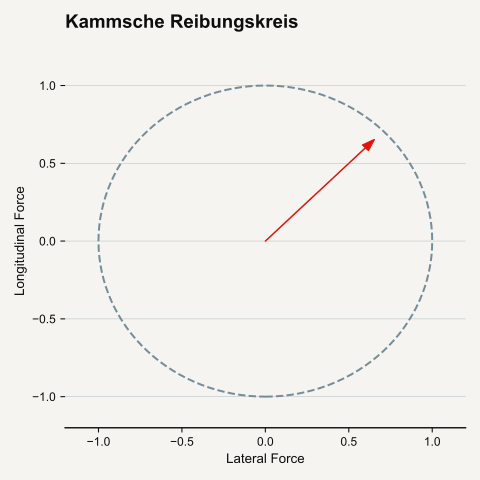
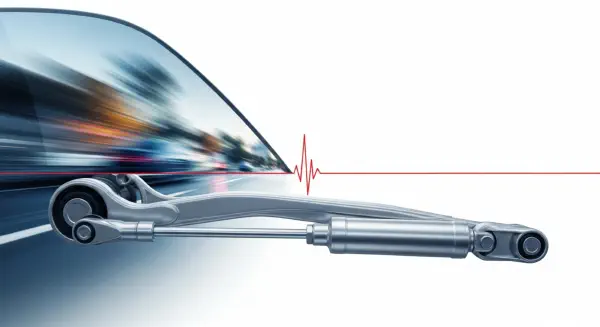
This brings us to the "Flower Model" of automotive architecture. If you look at a car not as a machine, but as a system of nested functions, you see that the "core" is the propulsion, but the "petals" are the user interfaces. Over the last century, we have seen the petals grow while the core has largely stagnated. We have spent billions of dollars on "scientification"—the process of turning the car into a predictable, measurable system. In the 1930s, engineers finally began to understand the car's behavior "as a whole". They developed the "Kammsche Reibungskreis" or Kamm’s Circle, a mathematical representation of the limits of tire grip. This allowed them to design suspensions that could compensate for the inherent instability of a heavy engine sitting over the front wheels.
Scientification: The mathematical enclosure of the car's physical limits.
The result of this "scientification" was the deskilling of the driver. In the 1900s, driving a car was an act of mechanical intimacy. You had to adjust the ignition timing manually depending on whether you were climbing a hill or starting the engine. You had to feel the slip of the clutch and the "bite" of the brakes, which were often just wooden blocks pressing against a metal drum. Modern automotive technology is a history of removing that intimacy. We replaced the manual spark advance with the centrifugal governor, then with the vacuum advance, and finally with the "Electronic Revolution" of the 1970s that placed a microprocessor between the driver’s foot and the engine's valves.
We call this progress. We say that the car became safer, more reliable, and more accessible. But look at the cost. The "Electronic Revolution" was not a leap forward in propulsion; it was a desperate attempt to keep the internal combustion engine alive in the face of emissions regulations—another Sailing Ship Effect. We added fuel injection, catalytic converters, and variable valve timing. We turned the engine into a computer-controlled life-support system for a 19th-century explosion cycle.
The "Pluto Effect" is still at work. We are now being told that the "Electric Revolution" is finally here. But notice how these new electric vehicles are designed. They are not designed to be better machines; they are designed to look and act exactly like the petrol cars they are replacing. They have the same 0-100 km/h (~0-62 mph) performance metrics. They have "simulated" engine noises pumped through the speakers. They have the same massive, heavy chassis designed for high-speed highway cruising. We are dragging our 20th-century habits—our need for "adventure," our obsession with "range," our desire for a private "cocoon"—into a new era.
The institutions that build these machines do not tell you this. The handbooks and the marketing materials rewrite the history of the car to make its current form seem inevitable. They tell a story of "normal change" and "incremental improvement". They hide the fact that the petrol car was a "social" choice made by a few thousand wealthy men in Paris and New York, a choice that locked the rest of the planet into a century of noise, vibration, and carbon.
The car is not a pinnacle of engineering. It is a monument to the Sailing Ship Effect. It is a machine that became incredibly complex just to avoid being replaced by something simpler. The most successful technology in human history is a 2,000 kg (~4,400 lb) steel box that spends 95% of its time parked and the other 5% burning liquid fossils to move a 75 kg (~165 lb) human three miles (~4.8 km) to a grocery store. We have spent a hundred years perfecting the most inefficient system imaginable.
Automotive history is not a record of progress. It is a record of how systems fail to change even when the evidence for change is overwhelming. We didn't choose the best engine. We chose the one that let us pretend we were explorers while we were really just sitting in traffic.
1769 – Cugnot’s Steam Dray
Nicolas-Joseph Cugnot builds the first self-propelled mechanical vehicle, a heavy steam-powered tricycle for hauling artillery.
1860 – The Lenoir Engine
Etienne Lenoir patents the first internal combustion engine, a two-stroke gas engine that proved the concept of "burning" fuel inside a cylinder.
1876 – The Otto Cycle
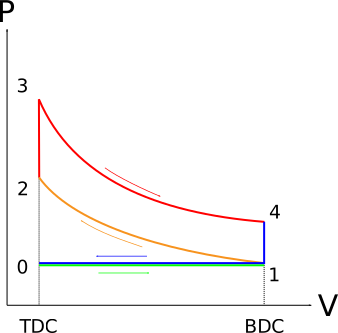
Nikolaus Otto perfects the compressed-charge, four-stroke cycle, creating the efficiency needed for a practical vehicle engine.The Otto cycle: intake, compression, power, exhaust.1886 – The Benz Patent-Motorwagen
Karl Benz receives the patent for a three-wheeled vehicle powered by a gas engine. Simultaneously, Gottlieb Daimler and Wilhelm Maybach produce a four-wheeled motorized carriage.
The 'Locked-In' Victory
1891–1912
1891 – The Panhard System
Panhard & Levassor introduce the front-engine, rear-wheel-drive layout with a sliding gear transmission. This "Systeme Panhard" becomes the architectural blueprint for the next century.
1901 – The Mercedes 35 HP
Considered the first "modern" car, it moves away from "motorized carriages" toward a low-center-of-gravity, steel-chassis machine.
1908 – The Ford Model T
Henry Ford introduces the Model T, shifting the car from an "adventure tool" for the wealthy to a mass-produced commodity through the moving assembly line.
1912 – The Electric Starter
Charles Kettering (GM/Delco) develops the electric self-starter for the Cadillac. This removes the physical barrier of the hand-crank, effectively killing the early market lead of electric vehicles.
The 'Scientification' of the Cocoon
1920–1960
1921 – Leaded Gasoline
Thomas Midgley Jr. discovers tetraethyl lead as an anti-knock agent, allowing for higher-compression, more powerful petrol engines at a massive environmental cost.
1930s – Independent Suspension
Manufacturers (led by European engineers) develop "scientified" suspension systems, allowing wheels to move independently and isolating passengers from the road.
1934 – The Citroën Traction Avant
Introduces mass-produced front-wheel drive and a "monocoque" (unibody) construction, further evolving the car as a rigid, safe "cocoon."
1952 – The Smog Discovery
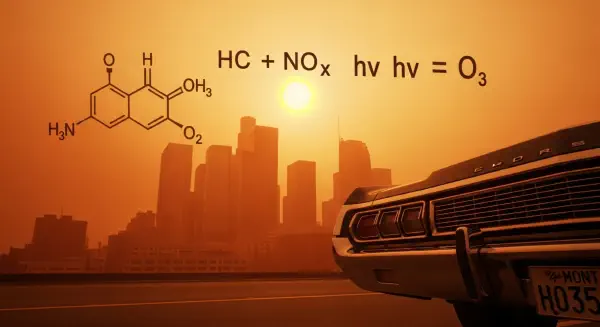
Arie Jan Haagen-Smit identifies the chemical link between automotive exhaust and atmospheric smog, beginning the era of environmental regulation.
The Electronic & Regulatory Revolution
1970–2000
1970 – The Clean Air Act
U.S. legislation forces a 90% reduction in emissions, leading to the "Sailing Ship Effect" where the petrol engine becomes infinitely more complex to survive.
1975 – The Catalytic Converter
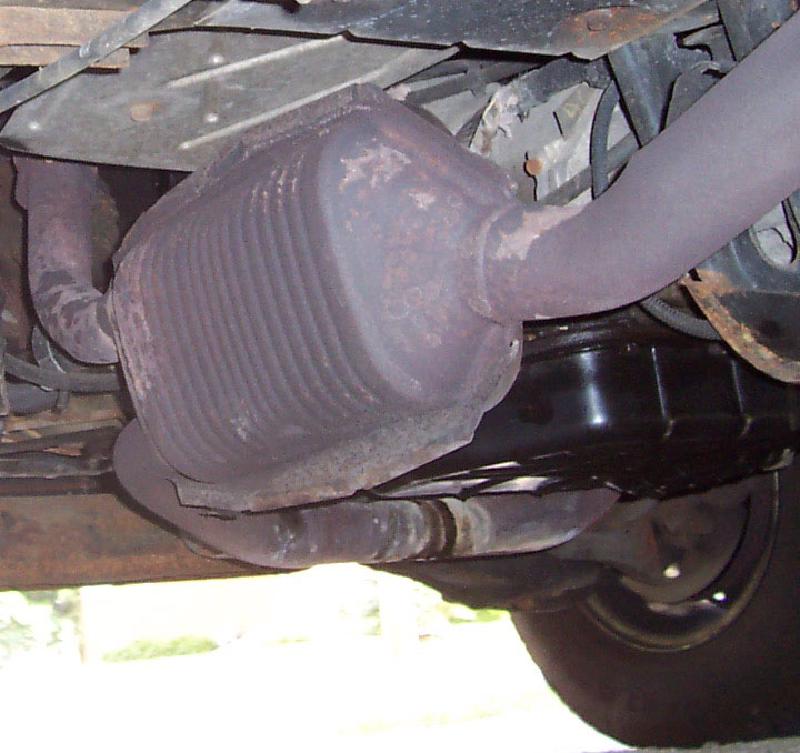
Becomes standard equipment to "scrub" exhaust, which in turn mandates the removal of lead from gasoline.The catalytic converter reduces harmful emissions.1980s – The ECU (Electronic Control Unit)
Microprocessors take control of fuel injection and ignition, replacing mechanical components and "deskilling" the driver.
1990 – The ZEV Mandate
California mandates the sale of Zero-Emission Vehicles, forcing the industry to revisit the electric propulsion it abandoned in 1912.
The Pacific Pivot & Automation
2000–Present
2008 – The Tesla Roadster
Proves that electric vehicles can be high-performance "status" objects, challenging the "city car" stigma.
2010s – The Rise of China
China "leapfrogs" internal combustion technology to become the global leader in battery production and EV market share.
Present – The Automated Capsule
The integration of AI and sensor suites (LiDAR/Radar) moves the car toward a "mobile device" where the human is a passenger rather than a driver.
The Paved Path: A Natural History of the Automotive Lie -
This article is part of a series.