
The Paved Path: A Natural History of the Automotive Lie
Key Insights#
The internal combustion engine achieved dominance by serving a social appetite for "adventure," using mechanical hacks to simulate the quiet efficiency of superior electric alternatives.
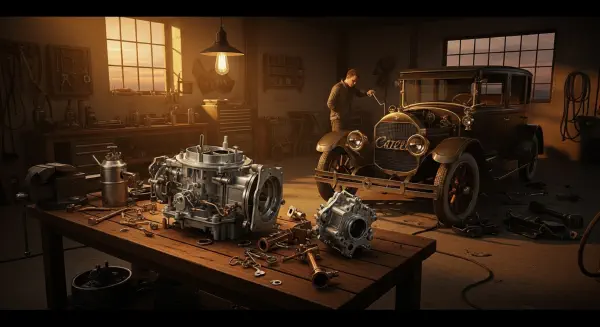
Innovation is frequently the "Sailing Ship Effect," where obsolete technologies—like the carburetor—become increasingly complex to avoid replacement by simpler, more efficient systems.
Through "scientification," engineers broke the physical intimacy between the driver and the road, transforming the car into an isolated, sensory-deprived private cocoon.
Automotive institutions weaponized lead and smog to protect a failing 19th-century explosion cycle, treating global neurotoxicity as a mere cost of technical inertia.
The "Electronic Revolution" was a microprocessor-led life-support system for the petrol engine, designed to satisfy emissions regulations while permanently deskilling the human operator.
The vehicle has devolved from an Atlantic symbol of mechanical mastery into a Pacific mobile device, where the digital interface has finally rendered the driver irrelevant.
References#
- Mom, G. (2023). The Evolution of Automotive Technology: A Handbook (2nd ed.). SAE International.
- U.S. Environmental Protection Agency (EPA). (1994). Milestones in Auto Emissions Control. Government Printing Office.
- California Air Resources Board (CARB). (1990). Proposed Regulations for Low-Emission Vehicles and Clean Fuels. Staff Report.
- Gartman, D. (1994). Auto Opium: A Social History of American Automobile Design. Routledge.
- International Organization of Motor Vehicle Manufacturers (OICA). (2021). 2000-2020 Sales Statistics..