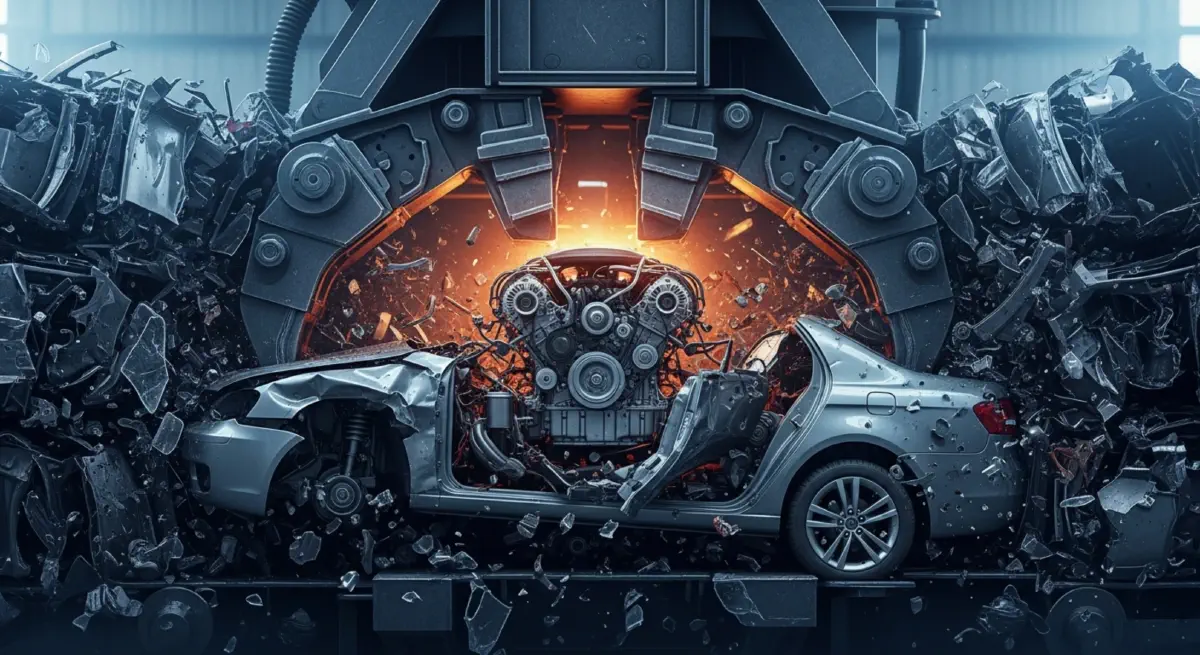
In 2024, a recycling facility in Jersey City processed its last internal combustion engine. The facility, one of the largest automotive shredders in the Northeast, had been in operation since 1978. Over its 46-year lifespan, it had shredded approximately 2.5 million vehicles, producing roughly 4 million tons of ferrous scrap and 1.2 million tons of non-ferrous metals, plastics, and automotive shredder residue—the technical term for the 20 to 25 percent of each vehicle that cannot be recycled and must be landfilled.
The final engine processed that day came from a 2012 Honda Civic with 148,000 miles. The vehicle had been declared a total loss after a minor collision that damaged its front subframe and deployed its airbags. The repair estimate—$5,800—exceeded the vehicle’s pre-accident value of $5,200. The insurance company paid the owner $4,900, sold the vehicle at auction for $1,200, and the dismantler who purchased it extracted the catalytic converter (sold separately for $400), the wheels and tires, and the battery before sending the remainder to the shredder.
The Civic’s engine—a 1.8-liter four-cylinder with no mechanical issues and an estimated remaining service life of 80,000 to 100,000 miles—was shredded with the rest of the vehicle. A buyer in West Africa would have paid $800 for the engine, but export logistics from New Jersey to Lagos or Tema add $600 in shipping, documentation, and tariffs. At $400 net, the dismantler chose to shred. The engine that could have powered another vehicle for a decade became, instead, 300 pounds of mixed metal scrap and 50 pounds of automotive shredder residue.
This is the end-of-life lie: the claim that vehicles are recycled at the end of their service life. They are, in a narrow sense—approximately 86 percent of a vehicle’s weight is recovered for material recycling, according to the Automotive Recyclers Association. But the distinction between “recycled” and “reused” matters. A vehicle that is shredded for its material content represents a loss of its functional value—the value embedded in its engineering, the energy embodied in its manufacturing, the potential service life remaining in its components. The environmental and economic accounting that treats shredding as recycling obscures the displacement of value from the use phase to the end-of-life phase, where it is systematically destroyed.
The Accounting Displacement#
The environmental impact of a vehicle is conventionally measured in grams of CO₂ per mile during operation. This is the metric that drives CAFE standards, that appears in EPA window stickers, that consumers use to compare models. It is also, by a substantial margin, the wrong metric.
A comprehensive lifecycle assessment—cradle-to-grave—accounts for three phases: manufacturing, operation, and end-of-life. For a conventional internal combustion vehicle, manufacturing accounts for approximately 15 to 20 percent of lifecycle emissions; operation accounts for 75 to 80 percent; end-of-life accounts for the remainder. This distribution has shaped regulatory focus for decades: if operation dominates, policy should target operational efficiency.
But the distribution changes when the vehicle’s lifespan changes. A vehicle that is scrapped at 100,000 miles rather than 200,000 miles effectively doubles the manufacturing emissions per mile driven, because the embedded emissions of production are amortized over half the distance. The 2012 Civic shredded in Jersey City had 148,000 miles at scrappage. Its manufacturing emissions—approximately 8 metric tons of CO₂ equivalent—were amortized over 148,000 miles, yielding 54 grams per mile from manufacturing alone. If it had reached 248,000 miles, manufacturing emissions would have been 32 grams per mile—a 40 percent reduction in the manufacturing phase contribution.
The regulatory structure does not account for this. CAFE credits are earned for operational efficiency, not for durability. The 2022 Inflation Reduction Act’s tax credits for new electric vehicles include no durability requirement; a vehicle that qualifies for the $7,500 credit may be scrapped after 100,000 miles with no consequence for the credit’s environmental accounting. The result is a system that incentivizes the production of vehicles with low operational emissions and undifferentiated durability—a combination that, in lifecycle terms, may be worse than producing a vehicle with modest operational emissions and exceptional durability.
The Export Market as Release Valve#
The global trade in used vehicles absorbs a substantial portion of the durability that the U.S. market discards. The United States exports approximately 800,000 used vehicles annually, according to the U.S. International Trade Commission. The primary destinations are West Africa, Central America, the Middle East, and Eastern Europe. These vehicles—which typically have 80,000 to 120,000 miles at export—will be driven another 50,000 to 100,000 miles before scrappage, effectively extending their service life by 50 to 100 percent.
The export market functions as a release valve for the maintenance trap. Vehicles that are no longer economically viable to repair in the United States—where labor rates exceed $100 per hour and parts costs reflect first-world supply chains—may be economically viable in countries where labor rates are lower, parts are sourced from salvage networks, and the value of the vehicle relative to income is higher. The 2007 Tundra that left Seattle for Central America in 2016 is now in its fourth or fifth country, still operating, still creating value from the engineering choices Toyota made eighteen years ago.
But the export market is not a solution to the end-of-life problem. It is a displacement of it. The emissions from shipping a vehicle 5,000 miles are modest relative to its remaining operational emissions, but the export market does not change the underlying economics: vehicles are exported when they are no longer economical to maintain in the country of origin, and they will eventually be scrapped in the destination country, often with less stringent environmental controls. The end-of-life lie is simply outsourced.
The Battery Problem#
Electric vehicles introduce a new end-of-life problem that makes the internal combustion challenge look tractable. A lithium-ion battery pack weighs 800 to 1,200 pounds and contains materials—lithium, cobalt, nickel, manganese—that are energy-intensive to extract and geographically concentrated. Recycling these materials is technically feasible but economically marginal.
The current recycling economics are inverted. A battery pack that has reached end-of-life—typically defined as 70 to 80 percent of original capacity—still has substantial residual value for second-life applications: stationary energy storage, grid buffering, backup power. But the economics of second-life deployment are uncertain, and the market for second-life batteries is immature. As a result, many end-of-life EV batteries are stored indefinitely, awaiting a recycling industry that does not yet exist at scale.
The 2024 U.S. Department of Energy’s battery recycling grant program allocated $125 million to develop domestic recycling capacity—a fraction of the investment required to process the 1.2 million EV batteries expected to reach end-of-life by 2030. The European Union’s Battery Regulation, effective 2027, mandates minimum recycled content requirements for new batteries and extended producer responsibility for end-of-life management. The United States has no comparable regulation. The result is a policy vacuum in which end-of-life batteries are likely to follow the same trajectory as end-of-life vehicles: exported to countries with weaker environmental standards, stored indefinitely, or landfilled.
The Embedded Energy Problem#
The energy embedded in a vehicle’s manufacturing—the energy required to mine its materials, smelt its steel, forge its components, assemble its parts—is substantial. A 2020 study by the Argonne National Laboratory estimated the embedded energy of a mid-size internal combustion vehicle at 100 gigajoules, equivalent to approximately 800 gallons of gasoline. An electric vehicle’s embedded energy is approximately 30 percent higher, reflecting the energy intensity of battery manufacturing.
When a vehicle is scrapped, that embedded energy is lost. The steel recovered from shredding requires remelting, which consumes approximately 70 percent of the energy required to produce virgin steel. The aluminum recovered requires approximately 90 percent of the energy for virgin production. The plastics—20 to 25 percent of vehicle weight—are typically not recycled at all; they become automotive shredder residue, which is either incinerated or landfilled. The embedded energy in the vehicle’s components is, with few exceptions, not recovered.
This is the fundamental inefficiency of the current end-of-life system. The industry has optimized for material recycling—the recovery of commodity metals—while ignoring component reuse, which preserves both the embedded energy and the functional value of the component. A used engine sold for reuse retains 100 percent of its embedded energy and provides 80,000 to 100,000 miles of additional service. An engine shredded for its aluminum content retains approximately 10 percent of its embedded energy and provides no additional service.
The economics of reuse are straightforward: they depend on the cost of removing, storing, and distributing components relative to their market value. For high-value components—engines, transmissions, turbochargers, electronic modules—reuse can be economic. For lower-value components—alternators, starters, water pumps—it often is not. The threshold is determined by labor costs, logistics costs, and the efficiency of the dismantling supply chain. In the United States, where labor rates are high and the dismantling industry is fragmented, the threshold is high. In countries with lower labor costs, it is lower.
The Structural Lie#
The end-of-life lie is not a conspiracy. It is a structural consequence of accounting boundaries that treat the vehicle’s life as ending when its first owner is done with it. The regulatory framework that measures fuel economy and emissions does not measure durability. The financial framework that amortizes manufacturing costs over the first owner’s loan term does not account for the value delivered to subsequent owners. The environmental framework that tracks operational emissions does not account for the embedded energy lost at scrappage.
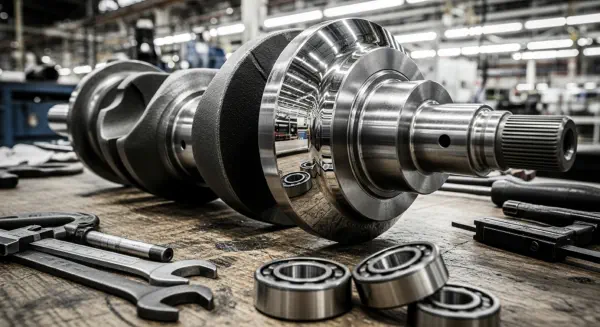
The 2012 Civic shredded in Jersey City was, by every regulatory measure, a success. It met its emissions standards. It delivered acceptable fuel economy. It was recycled at end-of-life—86 percent by weight, a figure the industry cites with pride. The engine that could have powered another vehicle for a decade became, instead, a line item in a recycling statistic. The energy that went into forging its crankshaft, machining its cylinder bores, assembling its valvetrain—all of it was lost. The value that Toyota engineers embedded in that engine was systematically destroyed by a system that had no way to account for it.
This is the final paradox of the engine that can’t be replaced. The engine itself—the core component that determines whether a vehicle lives or dies—is almost never the reason a vehicle is scrapped. The periphery fails. The economics of repair fail. The supply chain fails. The labor market fails. The export market absorbs some of the surplus durability, but not enough. The engine, in most cases, is still running when the vehicle enters the shredder. It is running when the crusher compresses the chassis into a 2,000-pound brick of mixed metal and plastic. It is running when the shredder tears it apart.
The engine that can’t be replaced is not the engine that fails. It is the engine that is discarded while it still runs.