The Engine That Can’t Be Replaced – Part 3: The End-of-Life Lie
·1780 words·9 mins
Examines the displacement of environmental and economic costs from the vehicle’s operation to its manufacturing and disposal phases.
Durability is a design choice with systematic economic consequences. Engineering for longevity increases manufacturing cost and reduces regulatory compliance (fuel economy) but delivers value over a longer service life. The market does not adequately reward this choice because the benefits accrue to second and third owners who had no role in the purchase decision.
Serviceability determines whether durability matters. A vehicle with a robust core but a serviceable periphery can achieve its potential lifespan. A vehicle with a durable core and an unserviceable periphery—due to design choices that prioritize manufacturing efficiency, parts supply chains that expire after 10 years, or labor markets that cannot support skilled repair—will be scrapped prematurely.
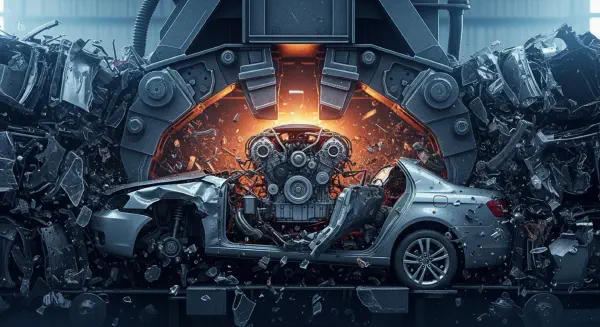
End-of-life accounting masks substantial value destruction. The automotive industry’s 86 percent recycling rate measures material recovery, not functional preservation. The embedded energy and functional value in components that are shredded rather than reused represent a loss that does not appear in any balance sheet or regulatory metric.
Regulatory structures systematically penalize durability. CAFE standards, EV tax credits, and emissions regulations reward operational efficiency but provide no credit for extended service life. The result is a fleet optimized for low operational emissions over an undefined lifespan, which may increase lifecycle emissions if vehicles are scrapped prematurely.
The global used-vehicle market absorbs durability that domestic markets discard. Export markets extend the service life of vehicles that are no longer economical to maintain in high-labor-cost countries, but this displacement does not solve the end-of-life problem—it moves it to countries with weaker environmental controls and less recycling infrastructure.
The transition to electric vehicles changes the durability problem without resolving it. EVs solve the mechanical durability challenge by eliminating most moving parts but introduce a new durability challenge in battery chemistry. The economics of battery replacement, parts availability for electronic components, and end-of-life battery recycling will determine whether EVs achieve their potential lifespan or replicate the maintenance trap of the internal combustion era.
Argonne National Laboratory. (2020). Cradle-to-grave lifecycle analysis of U.S. light-duty vehicle fuel pathways. U.S. Department of Energy.
Automotive Aftermarket Suppliers Association. (2015). Serviceability trends in North American light vehicles.
Automotive Recyclers Association. (2024). Vehicle recycling industry facts and figures.
Edmunds. (2024). Average new vehicle loan term reaches record high.
Gneezy, U., & Rustichini, A. (2000). A fine is a price. Journal of Legal Studies, 29(1), 1–17.
Massachusetts Right to Repair Coalition. (2022). Question 1: Right to Repair Law Implementation.
S&P Global Mobility. (2023). U.S. vehicle ownership trends and holding periods.
Schwartz, S. H. (1992). Universals in the content and structure of values: Theoretical advances and empirical tests in 20 countries. Advances in Experimental Social Psychology, 25, 1–65.
Tetlock, P. E. (2003). Thinking the unthinkable: Sacred values and taboo cognitions. Trends in Cognitive Sciences, 7(7), 320–324.
U.S. Bureau of Labor Statistics. (2025). Automotive service technicians and mechanics: Occupational outlook handbook.
U.S. Department of Energy. (2024). Battery recycling grant program: Fiscal year 2024 awards.
U.S. International Trade Commission. (2023). Used vehicle exports from the United States: Trends and destinations.
Volkswagen Group of America. (2003). Passat 1.8L turbo engine service manual.