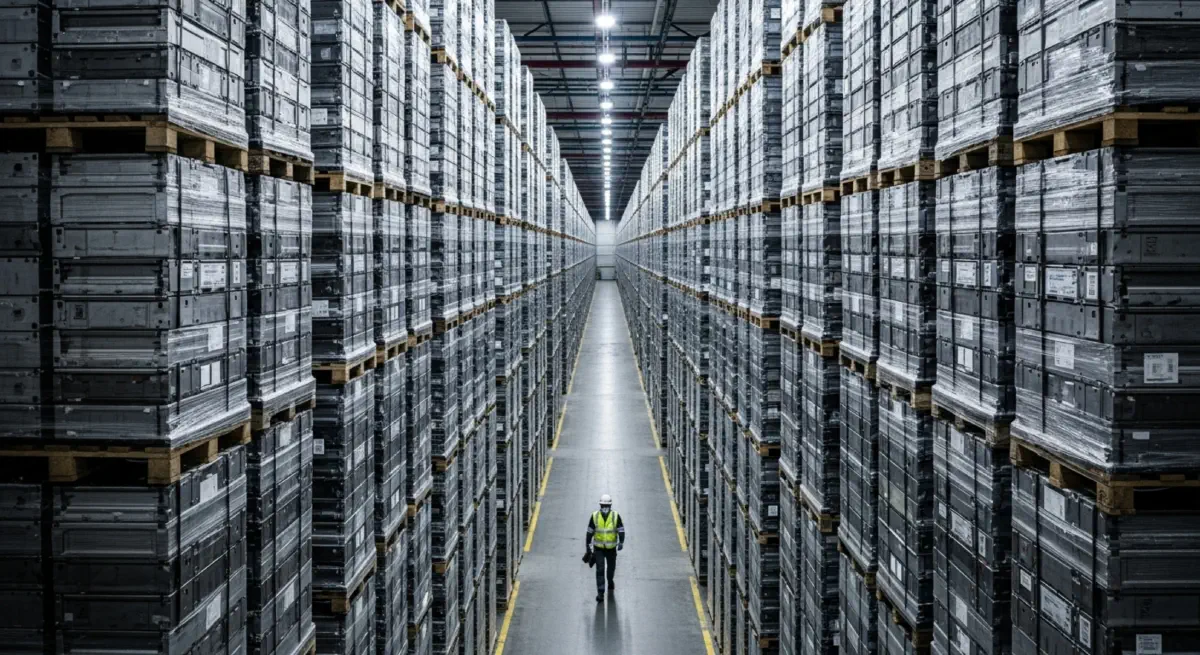
In a warehouse in Rotterdam, thousands of end-of-life electric vehicle battery packs are stacked, awaiting their fate. They contain valuable materials—lithium, cobalt, nickel—but also pose a fire risk and a complex disassembly challenge. The economics of recycling are precarious; it is often cheaper to mine new materials than to liberate these from their manufactured bonds. This growing stockpile represents a silent, ticking entry in the automotive ledger: a future cost that no current balance sheet fully captures. It is an “unaccountable”—an externality so diffuse, delayed, or complex that it defies neat quantification, yet whose potential impact is systemic.
The previous posts built a rigorous framework for energy and emissions accounting. But the true test of this framework is its ability to confront the messy, qualitative, and often geopolitical realities that numbers alone cannot contain. These are the costs displaced across system boundaries so vast they seem unrelated: the water stress in Andean communities, the concentration of mineral processing in a single adversarial nation, the fragility of a just-in-time global supply chain. To complete the balance sheet of motion, we must venture into the realm of the unaccountable, where traditional metrics fail and systemic risks loom.
These unaccountables are not mere footnotes; they are the potential failure modes of the entire energy transition. They determine whether the shift to electric vehicles builds a more resilient and equitable system or simply trades one set of dependencies and externalities for another, perhaps more severe, set. Accounting for them requires a new vocabulary—one of criticality, concentration, and cascading failure—to complement our language of grams and kilowatt-hours.
The Geopolitical Algebra of Critical Minerals#
The lifecycle ledger of a battery is written not only in CO2 but in geopolitical risk premiums. The supply chains for lithium, cobalt, nickel, and rare earth elements are hyper-concentrated. China refines 60% of the world’s lithium and 75% of its cobalt. Indonesia dominates nickel production. This creates a dependency structure with profound implications.
From a traditional accounting perspective, a ton of cobalt is a ton of cobalt, regardless of origin. From a systems risk perspective, cobalt from the Democratic Republic of Congo, where supply is vulnerable to artisanal mining disruptions, political instability, and ethical concerns, carries a different “risk weight” than cobalt from a more stable jurisdiction. This risk manifests as price volatility, supply shocks, and strategic vulnerability for entire national industries.
The response—diversifying supply chains or developing alternative chemistries (like LFP)—itself has ledger implications. Developing a new mine in a geopolitically stable country like Canada or Australia may have a higher upfront carbon footprint due to stricter environmental controls and higher labor costs, but it reduces long-term systemic risk. How does one account for the value of reduced risk? This is the algebra of resilience, a column missing from standard LCA spreadsheets.
The Circularity Gap#
End-of-life management is the Achilles’ heel of current accounting. Most LCAs optimistically assume a high recycling rate for batteries, often 90% or more, which dramatically reduces the need for future virgin material and its associated impacts. The reality is far grimmer. Today’s recycling infrastructure is nascent, and processes like pyrometallurgy (smelting) are energy-intensive and recover only a fraction of the materials.
The more efficient hydrometallurgy processes are complex and capital-heavy. The result is a massive circularity gap. The materials are technically recyclable, but the economic and industrial systems to do so at scale do not yet exist. By the time the first massive wave of EV batteries reaches end-of-life around 2035, we may face a stark choice: invest billions in recycling capacity or accept a landscape of hazardous waste and continued virgin material extraction. The cost of this future system is a deferred liability on today’s balance sheet, one that grows with every new EV sold.
The Fragility of Hyper-Optimization#
The modern automotive industry, in its quest for efficiency and cost reduction, has engineered a system of breathtaking optimization and profound fragility. The just-in-time supply chain, with single points of failure for specific semiconductors or components, is a hallmark of this. The 2021-2023 global chip shortage, which idled factories and crippled production, was a direct result.
Environmental optimization creates its own fragilities. Lightweighting vehicles with carbon fiber or aluminum improves efficiency but relies on energy-intensive materials with concentrated supply chains. Relying on a single, optimal battery chemistry (like high-nickel NMC) for maximum range makes the entire industry vulnerable to shocks in that specific material market.
This is the paradox of optimization under narrow constraints. When you optimize solely for one metric—be it cost, weight, or energy density—you invariably make the system more brittle to disruptions in the parameters you ignored. A full accounting must therefore include a “resilience premium” or acknowledge the systemic risk of lean, globalized, mono-cultural supply chains. The COVID-19 pandemic and the blockage of the Suez Canal were stress tests this system barely passed.
The Social and Ecological Externalities#
Finally, the ledger must grapple with impacts that resist monetization but are nonetheless real. What is the cost of the water consumed by lithium brine extraction in an arid region, measured not in dollars but in community displacement and ecosystem loss? What is the value of biodiversity degraded by nickel mining in rainforests? What is the social cost of shifting pollution from urban tailpipes to the fence-line communities surrounding coal-fired smelters and gigafactories?
These are externalities in their purest form: costs borne by parties who did not choose to incur them and are not compensated. Traditional economics struggles to price them, but environmental justice demands we name them. They represent a moral debt. While tools like the “social cost of carbon” attempt to bring some of these costs into the fiscal world, many remain in the realm of ethical accounting.
Towards an Honest Ledger#
Accounting for the unaccountable does not mean achieving perfect precision. It means acknowledging the limits of our models and the existence of costs that our spreadsheets currently omit. It means adopting a precautionary principle: where data is incomplete but risks are systemic (e.g., battery recycling, geopolitical concentration), we must build buffers and diversify pathways.
The ultimate insight from a complete lifecycle audit is that the automobile is not a siloed product. It is a temporary configuration of global flows—of energy, materials, capital, and risk. Its true cost is the sum of all the disturbances it creates along those flows, from the mine to the scrapyard.
A honest ledger would therefore have multiple columns: Carbon, Cost, Criticality, Circularity, and Equity. No vehicle will score perfectly on all five. But by making these trade-offs explicit, we can make informed choices. Do we prioritize a lower carbon footprint today if it means intolerable geopolitical risk tomorrow? Do we accept higher upfront costs for a more circular design?
The balance sheet of motion, when fully rendered, is not just a technical document. It is a manifesto for a more holistic, resilient, and just system of mobility. It tells us that cleaning up the car was the easy part. The hard part is cleaning up the world that builds it.