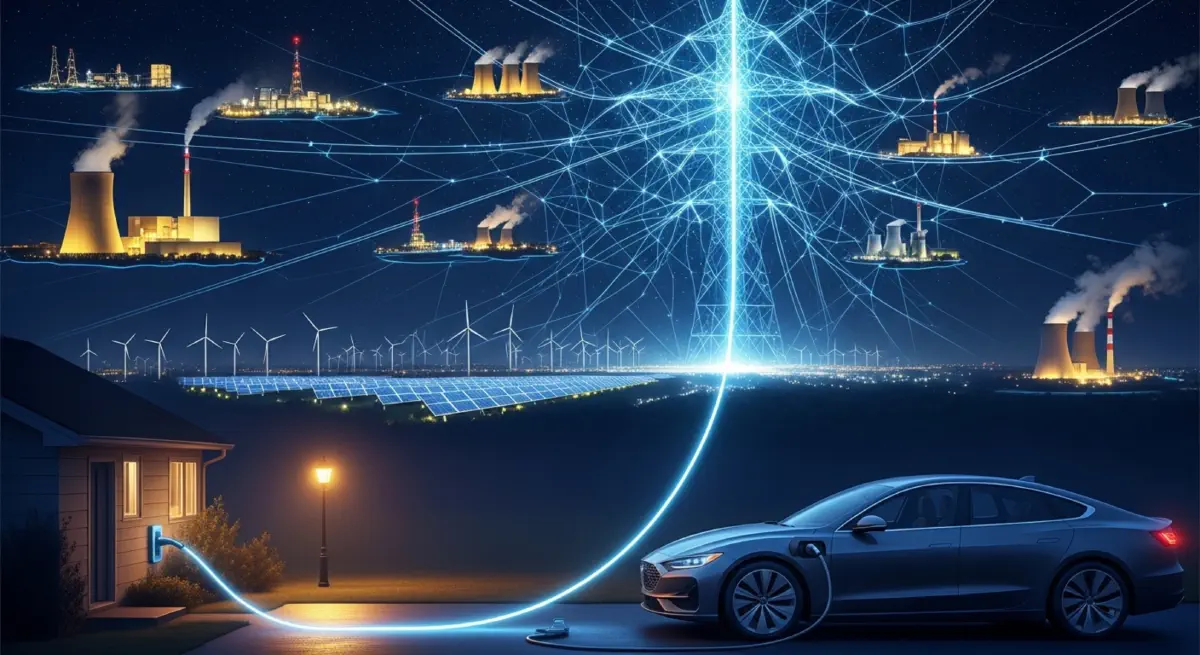
On a windless, overcast afternoon in Germany, the nation’s network of 1 million electric vehicles begins its evening charge. The demand is met not by the country’s celebrated wind turbines, which sit idle, but by a surge in output from lignite coal plants and natural gas turbines. In that moment, each plugged-in EV is responsible for over 600 grams of CO2 per kilowatt-hour—a footprint worse than that of a modern gasoline hybrid. This is not a failure of the vehicle, but a revelation of its deepest dependency: the electric car is the only automobile whose environmental signature is authored in real-time by the invisible hand of the electrical grid.
An EV has no tailpipe, but it has a virtual smokestack that stretches to every power plant on the network. Its core promise—zero emissions—is therefore a contingent one, entirely dependent on the cleanliness of the infrastructure that feeds it. This transforms the environmental ledger from a static calculation into a dynamic, location-specific, and time-sensitive model. The “fuel” is not a homogeneous liquid but a fluctuating stream of electrons, each with its own provenance and pollution profile. To account for an EV’s impact, we must simultaneously audit the sprawling, aging, and often fragile machine we call the power grid.
This dependency creates both a profound opportunity and a critical vulnerability. It means an EV’s benefits are not intrinsic but must be engineered at the systems level. It also means that mass EV adoption, unmanaged, could strain grid infrastructure to its breaking point, potentially locking in fossil fuel dependency for decades. The grid doesn’t just power the EV; it ultimately defines its environmental and economic value.
The Critical Distinction: Average vs. Marginal Emissions#
Standard lifecycle assessments for EVs often use an “average grid mix” to assign emissions—total generation divided by total emissions. This is a useful but misleading simplification for policy. The analytically rigorous approach focuses on marginal emissions: what specific power source is ramped up or down to meet the incremental demand of one more EV plugging in?
When solar and wind generation are high and demand is low (a sunny, breezy afternoon), the marginal unit of electricity may be renewable, and the EV’s charge is nearly carbon-free. During the evening “peak” period, when demand spikes and solar generation fades, the marginal unit is often a natural gas “peaker” plant or, in some regions, a coal plant. Charging during this peak directly triggers higher emissions.
The difference is staggering. Economist Steve Cicala’s research shows marginal emissions rates can be 20-50% higher than average rates. An EV owner who charges exclusively at 7 PM may be responsible for 50% more indirect emissions than standard models predict, dramatically extending the carbon payback period calculated in Part 2. Smart charging—delaying the charge to overnight when wind power is often abundant—can slash this footprint. The EV’s ledger, therefore, has a time stamp.
The Battery as a Grid Asset, Not Just a Load#
This volatility introduces a transformative possibility: if EVs are a problem of grid management, their batteries could also be part of the solution. This is the promise of vehicle-to-grid (V2G) technology and smart, aggregated charging.
If millions of EV batteries could be used as a distributed energy resource, they could store excess renewable energy when it’s plentiful and feed it back to the grid during peaks, displacing fossil fuel generation. A 2020 study from the University of California, Berkeley, estimated that optimized charging of the future U.S. EV fleet could reduce grid management costs by billions annually and significantly cut emissions.
The potential is immense, but the current reality is far from it. Realizing this vision requires widespread bidirectional charging hardware, sophisticated software platforms, and new regulatory markets to compensate vehicle owners. Today, the unmanaged EV fleet is largely seen by grid operators as a costly, unpredictable new demand, a risk to stability that necessitates expensive grid upgrades.
The Hidden Infrastructure Overhead#
Supporting tens of millions of EVs requires more than just generating clean electricity; it requires a complete re-engineering of the transmission and distribution network. The U.S. grid, a patchwork averaging over 40 years old, was not designed for this concentrated, high-power load.
The challenge is most acute at the local distribution level. Residential neighborhoods are served by transformers and power lines sized for 20th-century appliance loads. A single Level 2 charger (7-11 kW) can double a typical household’s peak demand. A cluster of EVs charging simultaneously on one block could easily overload local infrastructure, leading to brownouts or necessitating multi-billion-dollar upgrades.
These upgrade costs—from neighborhood transformers to new high-voltage transmission lines—are socialized across all ratepayers. This is a massive, often unaccounted externality. The EV owner benefits from lower “fuel” costs, while the system-wide cost of reinforcing the grid is shared by everyone, including households without cars. Honest lifecycle accounting must allocate a portion of this multi-trillion-dollar grid modernization burden to the EV, a column rarely included in its environmental or economic ledger.
The Cascading Material Demand#
The clean grid needed to unlock the EV’s potential is itself a monumental industrial project of renewable energy and storage. This creates a secondary, cascading demand for critical materials, further stressing the supply chains dissected in Part 2.
Solar panels require polysilicon, silver, and copper. Wind turbines need rare earth elements for permanent magnets. Grid-scale battery storage needs lithium, cobalt, and nickel. A 2021 International Energy Agency report highlighted that a solar farm requires about 3 tons of copper per megawatt; an offshore wind farm requires up to 15 tons per megawatt.
Thus, the electrification of transport and the decarbonization of power are not separate challenges; they are two fronts of the same material-intensive campaign. This interdependence creates a profound systemic fragility: a shortage or geopolitical shock in, for example, copper, could simultaneously constrain the rollout of both EVs and the renewable generation needed to charge them cleanly. It is a self-reinforcing loop of demand that the linear models of traditional automotive accounting fail to capture.
The Inescapable Interdependence#
The narrative of the EV as a self-contained solution is a seductive but dangerous fiction. Its environmental ledger cannot be closed within the boundaries of the vehicle itself. It is irrevocably tied to the carbon intensity of the marginal kilowatt-hour, the resilience of the distribution grid, and the material footprint of the energy transition.
This means there is no single answer to “How clean is an electric car?” The answer is always, “It depends.” It depends on your postal code, the time on your charging timer, the pace of your grid’s decarbonization, and whether your vehicle is a passive load or an active grid asset.
Therefore, the policy challenge is monumental. It is no longer sufficient to subsidize vehicle purchases. Success requires a concurrent, colossal investment in modernizing, expanding, and greening the electrical grid. It requires electricity market designs that reward smart charging and V2G services. It demands a holistic, systems-level view that inextricably links transportation policy with energy, industrial, and trade policy.
The grid’s invisible hand writes the final, and most decisive, entry in the EV’s ledger. Ignoring it is not just bad accounting; it is a guarantee of failed outcomes.