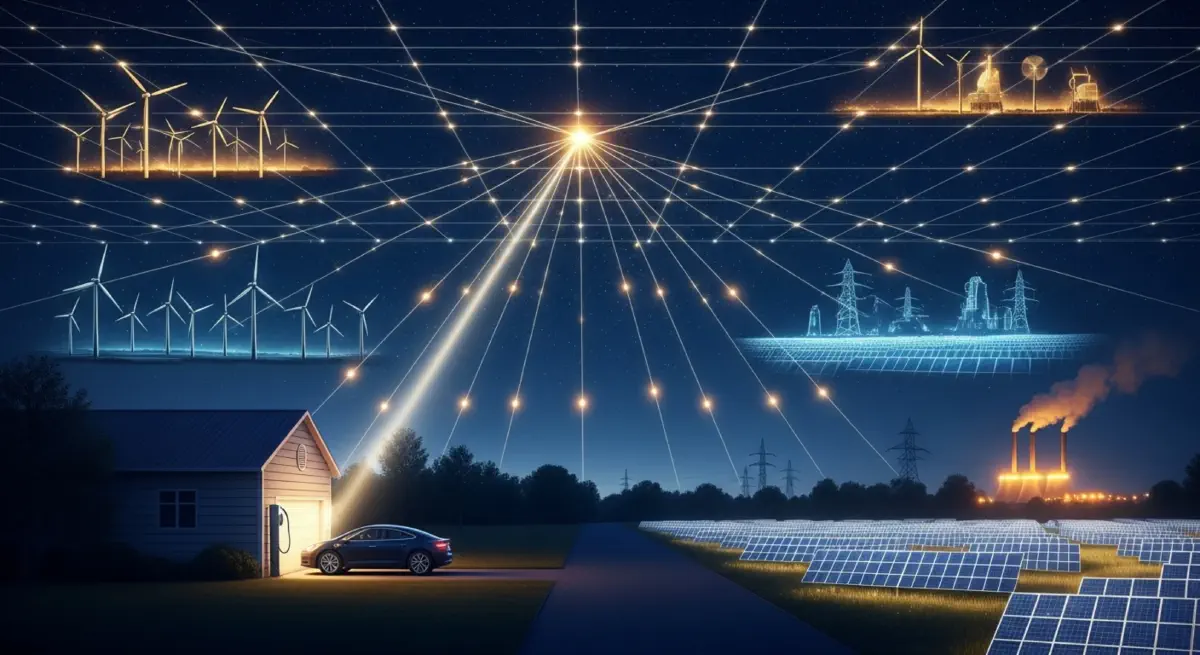
On a still, cold winter evening in January 2023, the managers of California’s electrical grid issued an unprecedented alert to the state’s electric vehicle owners: “Avoid charging your EV during peak hours tonight.” The state was straining under high demand, and the marginal electricity—the last megawatt needed to keep the lights on—was coming from natural gas “peaker” plants, some of the grid’s dirtiest and least efficient generators. In that moment, the clean EV was being powered by decidedly dirty electrons. This incident was not a failure of the technology, but a revelation of its deepest dependency.
An electric vehicle is the only car whose environmental signature is rewritten in real-time. A gasoline car burns the same fuel, from the same geologic source, every day. An EV’s energy source changes by the hour, dictated by the chaotic dance of supply and demand on the electrical grid. Its “tailpipe” is effectively the collective smokestack of every power plant on the network. This means the EV’s core promise—zero emissions—is a contingent one, entirely dependent on the infrastructure that feeds it. The vehicle’s ledger, therefore, cannot be closed by analyzing the car alone. It requires a simultaneous audit of the sprawling, aging, and often fragile machine we call the power grid.
This transforms the environmental equation from a static calculation into a dynamic, location-specific, and time-sensitive model. An EV charged overnight in Iowa, where wind power often dominates the nighttime mix, is a different environmental actor than one charged at noon in West Virginia, where coal may be the marginal source. This dependency creates both a profound opportunity and a critical vulnerability for the energy transition. The EV doesn’t just consume electricity; it becomes a massive new load on a system already facing unprecedented stresses from climate change and the integration of intermittent renewables.
The Dynamic Calculus of Clean Miles#
The Marginal Mix Mirage#
Lifecycle accounting for EVs traditionally uses an “average grid mix” to assign emissions—taking the total generation for a region and dividing by the total emissions. This is useful for policy but misleading for real-world impact. The correct analytical lens is the marginal emissions factor: what source of power is ramped up or down to meet the incremental demand of plugging in one more car?
When demand is low and renewable generation is high (e.g., a sunny, windy afternoon), the marginal unit might be solar or wind, and the EV’s charge is nearly carbon-free. During the “peak” period of high demand (early evening), when solar fades and people return home, the marginal unit is often a natural gas combustion turbine or, in some regions, a coal plant. Charging during this peak period directly triggers higher emissions. Studies from economists like Steve Cicala show that the marginal emissions rate can be 20-50% higher than the average rate. An owner charging exclusively at peak, therefore, may be responsible for far more indirect emissions than standard models suggest.
The Battery as a Grid Asset#
This volatility introduces a powerful two-way relationship: the grid shapes the EV’s impact, but EVs, managed intelligently, could help shape the grid. This is the promise of vehicle-to-grid (V2G) technology and smart charging. If millions of EV batteries could be aggregated as a distributed energy resource, they could store excess renewable energy when it’s abundant and feed it back during peaks, displacing fossil fuel generation.
The potential is immense. A 2020 study by the University of California, Berkeley, estimated that optimized charging of the future U.S. EV fleet could reduce the cost of grid management by billions annually and significantly cut emissions. However, this remains largely theoretical. Realizing it requires widespread adoption of bidirectional charging hardware, sophisticated software platforms, and new regulatory and market structures to compensate vehicle owners. The current reality is that the unmanaged EV fleet is largely seen by grid operators as a costly, unpredictable new demand, a risk to stability.
The Strain of Megawatts and Metals#
The Infrastructure Overhead#
Supporting tens of millions of EVs requires more than just generating clean electricity; it requires transmitting and distributing it. The U.S. grid, a patchwork system averaging over 40 years old, was not designed for this load. Residential neighborhoods, where most overnight charging will occur, are served by transformers and distribution lines sized for 20th-century appliance loads. A single Level 2 charger (7-11 kW) can double a typical household’s peak demand.
A mass, simultaneous charging event in a suburban area could easily overload local infrastructure, leading to brownouts or expensive upgrades. These upgrade costs—spanning from neighborhood transformers to interstate transmission lines to new generation capacity—are socialized across all ratepayers. This is a classic externality: the EV owner benefits from lower “fuel” costs, while the system-wide cost of reinforcing the grid is shared by everyone, including those without cars. Honest accounting must allocate a portion of this multi-trillion-dollar grid modernization burden to the EV lifecycle.
The Secondary Material Cascade#
The clean grid needed to truly unlock the EV’s potential is itself a massive industrial project of renewable energy and storage. This creates a secondary, cascading demand for critical materials, further stressing the very supply chains examined in Part 2. Solar panels require polysilicon, silver, and copper. Wind turbines need rare earth elements for permanent magnet generators. Grid-scale battery storage needs lithium, cobalt, and nickel.
Pursuing a clean grid to power clean cars therefore creates a self-reinforcing loop of mineral demand. A 2021 International Energy Agency report highlighted that a solar farm requires about 3 tons of copper per megawatt; an onshore wind farm requires up to 4 tons per megawatt. The electrification of transport and power generation are not separate challenges; they are two fronts of the same material-intensive campaign. This interdependence creates a systemic fragility: a shortage or price shock in, say, copper could simultaneously constrain the rollout of both EVs and the renewable generation needed to charge them cleanly.
The Inescapable Interdependence#
The narrative of the EV as a self-contained solution is a seductive fiction. Part 1 exposed the tailpipe illusion. Part 2 uncovered the battery’s buried debts. This final analysis reveals the ultimate dependency: the EV is a node on a network, and its environmental value is dictated by that network’s health, cleanliness, and resilience.
The grid’s silent signature on the EV’s ledger means there is no single answer to “How clean is an electric car?” The answer is, “It depends.” It depends on where you live, when you charge, how quickly your grid decarbonizes, and whether your vehicle’s battery can be integrated as a grid asset rather than just a load.
This transforms the policy challenge. It is no longer sufficient to subsidize vehicle purchases. Success requires a concurrent, massive investment in modernizing, expanding, and greening the electrical grid. It requires market designs that reward smart charging. It demands a holistic, systems-level view that links transportation policy with energy, industrial, and trade policy.
The automobile’s environmental ledger, once thought to be a simple record of fuel burned, is now a complex document of globalized industrial flows, geopolitical dependencies, and networked energy systems. Accounting for it all reveals a difficult truth: we are not simply replacing one type of car with another. We are attempting to rewire the material and energetic foundations of modern mobility. The numbers in the ledger show that the success of this endeavor is still being written, one electron and one policy decision at a time.