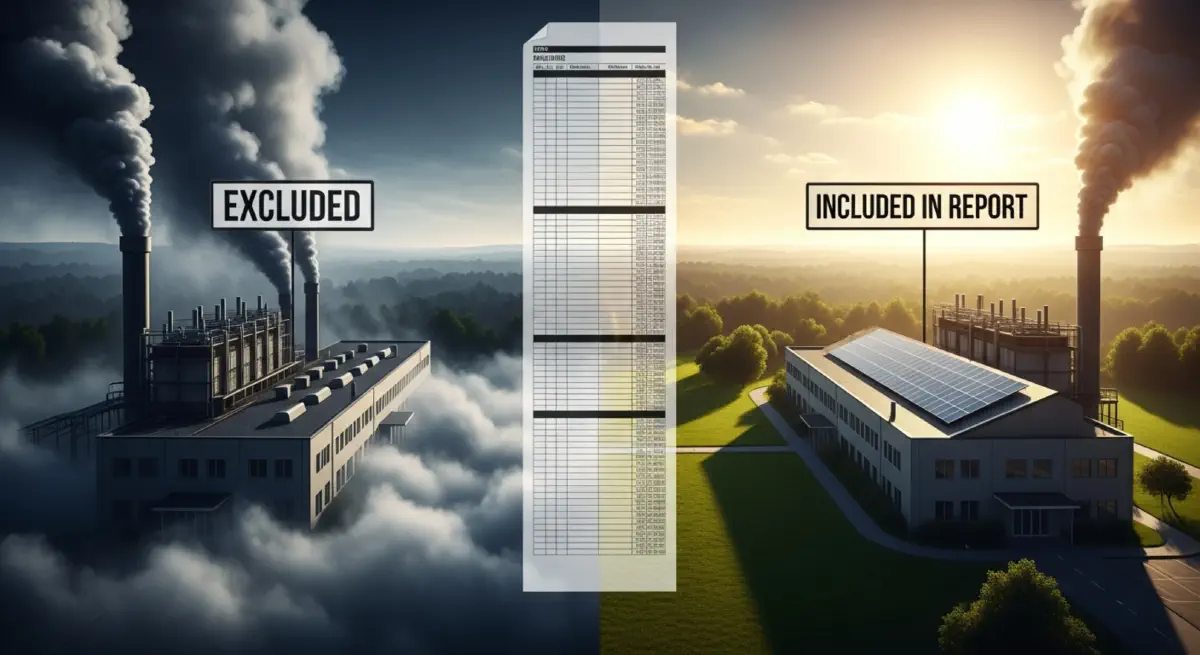
In 2015, as part of its ambitious climate pledge, a major European automaker announced it would achieve “carbon neutrality” in its vehicle production by 2022. The press release featured gleaming solar panels on factory roofs and closed-loop water systems. What it did not feature was a detailed methodological appendix. By 2022, the company triumphantly declared mission accomplished. The fine print, buried in a sustainability report, revealed the trick: the accounting boundary. The claimed neutrality applied only to “Scope 1” and “Scope 2” emissions—those from factory boilers and purchased electricity. The vast majority of the car’s carbon footprint—the “Scope 3” emissions from steelmaking, aluminum smelting, battery cell production, and parts manufacturing in its supply chain—was excluded from the calculation. The automaker had not decarbonized its production; it had simply redrawn the map of what counts.
This is the foundational battle in the accounting wars: the system boundary selection. Lifecycle assessment (LCA) presents itself as objective science, but its first and most consequential step is an arbitrary, political choice: where do you draw the line around the system you’re measuring? This choice determines whether an electric vehicle appears as a silver bullet or a contingent solution, whether a nation’s emissions are falling or simply being outsourced. The boundary is the invisible frame that makes some impacts visible and renders others irrelevant. In the hands of corporations and governments, it becomes a tool not for illumination, but for statistical laundering.
The power of boundary selection stems from a basic truth: environmental impacts do not respect corporate organizational charts or national borders. Carbon molecules released by a coal-fired power plant in Poland that supplies an aluminum smelter, which sells to a German battery component maker, which supplies a French gigafactory, which ships cells to a Spanish assembly plant, become part of a Spanish-made EV’s lifecycle footprint. Whether they appear on any single entity’s ledger depends entirely on the accounting rules. This fragmentation allows for what scholars call carbon leakage—not the physical movement of pollution, but its methodological disappearance through clever bookkeeping. To understand modern environmental claims, one must first locate the erased borders.
The Hierarchy of Omission#
The Corporate Playbook: Scoping the Unscoped#
The Greenhouse Gas Protocol’s “Scopes” framework (Scope 1: direct emissions; Scope 2: indirect from purchased energy; Scope 3: all other indirect emissions) was created to bring order. In practice, it has created a hierarchy of accountability. Scope 3 emissions—which for an automaker typically constitute 75-90% of the total lifecycle footprint—are often reported as “optional” or are calculated using generic industry averages instead of primary supplier data.
This allows for a potent corporate strategy: aggressively decarbonize the visible, high-profile Scopes 1 & 2 (install factory solar, buy renewable energy certificates) while applying gentle pressure or vague targets to the massive, messy Scope 3 supply chain. The public sees a “100% renewable-powered factory” and assumes a green product. The ledger, if fully drawn, might tell a different story of carbon merely displaced to subcontractors in jurisdictions with weaker reporting standards. The choice to exclude Scope 3 is not a technical limitation; it is a political and economic decision that protects complex, cost-sensitive supply chains from scrutiny.
The National Accounting Shell Game#
This boundary game is played even more dramatically at the national level. Under the United Nations Framework Convention on Climate Change (UNFCCC), countries report emissions based on territorial accounting: what is emitted within their geographic borders. This creates powerful incentives for emissions offshoring.
A canonical example is the Western world’s consumption of Chinese-manufactured goods. As Western nations deindustrialized and imported more from China, their territorial emissions appeared to plateau or fall. However, their consumption-based emissions—counting the carbon embedded in all goods they consume, regardless of where produced—continued to rise. Between 1990 and 2015, the UK’s territorial emissions fell by 38%, but its consumption-based footprint fell by only 15%. The difference was made up by increased imports of embedded carbon, primarily from China. The climate system responds to global emissions, not territorial ones, making this accounting choice a dangerous fiction of progress.
The Technical Tools of Obfuscation#
The “Cut-off” and “Allocation” Rules#
Within an LCA, two technical mechanisms serve as precise tools for boundary manipulation. The cut-off rule dictates when a material input is considered “zero burden.” For example, if a manufacturer uses recycled aluminum, many LCAs assign it a near-zero carbon footprint, ignoring the energy-intensive collection, sorting, and re-melting processes. This incentivizes the use of recycled content but can disincentivize investments to make the recycling process itself cleaner.
Allocation is even more consequential. How do you divide the environmental burden when a single process produces multiple outputs? In a petroleum refinery producing gasoline, diesel, and petrochemical feedstocks, how do you allocate the emissions? The default method is often based on mass or economic value. But change the allocation rule to “energy content” or “market value,” and the carbon assigned to a liter of gasoline can shift by 20% or more. For biofuels, allocation choices can determine whether a fuel shows a 80% reduction or a 20% increase versus gasoline. The result is not error, but controlled variance—a range of “correct” answers from which the most favorable can be selected.
The Temporal Boundary: Ignoring Legacy and Lock-in#
Perhaps the most significant omission is temporal. Standard LCAs are static snapshots of a product made today. They fail to account for path dependency and infrastructure lock-in. Building a new vehicle platform or a gigafactory represents a capital investment with a 20-30 year operational lifespan. The emissions from operating that asset over its lifetime are a future cost, but the decision committing to those emissions is made today. By not accounting for this “committed emissions” or “carbon inertia,” LCAs favor technologies that are marginally better now but lock in long-term, sub-optimal pathways. They account for the fuel in the tank but ignore the steel in the highway and the concrete in the factory.
The Power of the Drawn Line#
The lesson of boundary selection is that the map is not the territory, but it controls the territory. The rules of accounting determine where capital flows, which technologies receive subsidies, and what consumers believe they are buying. A system that counts factory emissions but not mining emissions will optimize for clean factories, not clean mines. A system that counts territorial emissions but not consumption will incentivize offshoring, not decarbonization.
Therefore, evaluating any environmental claim requires a first, forensic question: What is inside the frame, and what has been cropped out? The boundary is never neutral. It is the primary instrument of power in the accounting wars, deciding what costs remain internal to a balance sheet and what costs are successfully externalized to society, the global poor, and future generations. The fight for a sustainable future is, in no small part, a fight over who gets to draw the lines.