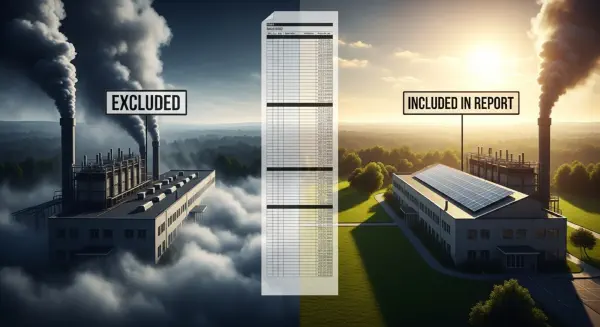

The Accounting Wars: How Rules Shape Reality

Key Insights
#

  • Accounting is a Political Act, Not a Neutral Science: The foundational choices in lifecycle assessment—where to draw system boundaries, how to value future damage, which pollutants to prioritize—are value judgments that determine winners and losers. These choices are often disguised as technical necessities.
  • Externalization is the Primary Goal of Corporate & National Accounting: The strategic exclusion of Scope 3 emissions, consumption-based accounting, and the use of high discount rates in the Social Cost of Carbon are not errors but deliberate tools to make environmental liabilities disappear from a balance sheet, socializing costs while privatizing benefits.
  • Monometric Optimization Leads to Systemic Failure: The diesel scandal is the archetypal case of optimizing for a single, poorly-measured metric (lab-tested CO₂). This created perverse incentives that sacrificed public health (NOₓ emissions) for marginal, deferred climate gains, demonstrating that incomplete accounting can be deadly.
  • Abstract Numbers Dictate Tangible Reality: The Social Cost of Carbon (SCC), a highly abstract and malleable figure, directly shapes trillion-dollar infrastructure investments and regulatory standards. Its derivation is fraught with ethical assumptions about the value of the future, making it a potent weapon in policy battles.
  • Robust Policy Requires Multi-Parametric, Real-World Accounting: Sustainable solutions demand accounting frameworks that internalize all externalities (climate, health, ecosystems), measure performance under real-world conditions, and assess full lifecycle impacts. Simplistic, single-score metrics will inevitably be gamed and lead to catastrophic unintended consequences.

References
#

  1. Greenhouse Gas Protocol. (2011). Corporate Value Chain (Scope 3) Accounting and Reporting Standard. World Resources Institute and World Business Council for Sustainable Development.
  2. Interagency Working Group on Social Cost of Greenhouse Gases. (2021). Technical Support Document: Social Cost of Carbon, Methane, and Nitrous Oxide. United States Government.
  3. European Federation for Transport and Environment. (2016). Dieselgate: Who? What? How? Transport & Environment Report.
  4. Barrett, S. R., et al. (2015). Impact of the Volkswagen emissions control defeat device on US public health. Environmental Research Letters, 10(11).
  5. PBL Netherlands Environmental Assessment Agency. (2020). Trends in global CO2 and total greenhouse gas emissions: 2020 Summary Report.