Why the Global Auto Industry’s Pivot to Electrification Stalled Against Economic Reality#
Three years ago, the global automotive industry succumbed to a collective hallucination, a fever dream fueled by the shimmering mirage of Tesla’s trillion-dollar valuation. From the glass towers of Wolfsburg to the sprawling boardrooms of Detroit, executives looked at their internal combustion assembly lines not as the engines of 20th-century prosperity, but as liabilities to be liquidated. They convinced themselves, and more importantly, their shareholders, that they were merely one battery factory away from trading at the tech-sector multiples usually reserved for software monopolies. Volkswagen (VW) grandiosely promised that 70 percent of its European sales would be electric by 2030, a figure it later hubristically revised upward to 80 percent. Stellantis pledged a total, one hundred percent transition. Even General Motors (GM), a company historically defined by its cautious incrementalism and reliance on the steady margins of heavy steel, set a hard 2035 deadline to abandon the internal combustion engine entirely.
It was a time of easy promises made in an era of zero percent interest rates and political leaders eager to write checks with other people’s money. The transition was framed as an inevitability—a moral and technological tidal wave that would sweep away the pistons and spark plugs of the past. But in late 2025, that wave has not merely slowed; it has broken against the jagged rocks of consumer pragmatism and the cold math of manufacturing. The "field of dreams" era of electric vehicle (EV) manufacturing—the belief that if you built the batteries, the buyers would magically appear—has ended in a series of multi-billion-dollar capitulations.
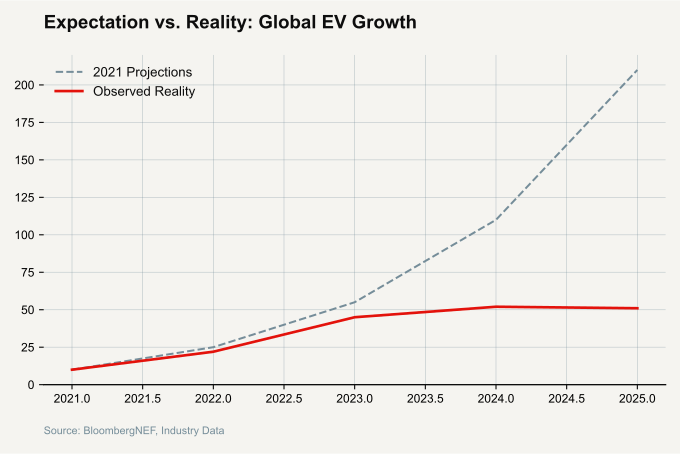
The reality check arrived with surgical precision this autumn. In the United States, the sudden withdrawal of the <span>$</span>7,500 federal consumer tax credit removed the artificial floor that had supported the domestic market. For years, this subsidy had tipped the economic scales, masking the fundamental price disparity between a gas-powered crossover and its battery-electric equivalent. Without it, the "organic" demand for EVs was revealed to be a precarious niche. Across the Atlantic, the European Commission, bowing to the existential screams of its domestic manufacturers, quietly began the single largest walk-back of green industrial policy in the history of the bloc. By replacing its absolute 2035 ban on combustion engines with a "90 percent target" and a maze of offsets, Brussels conceded that its flagship policy was colliding with the laws of economics. The global inevitability of the EV has dissolved into a fragmented patchwork of regional markets, defined less by engineering breakthroughs and more by who is currently writing the largest checks.
While China continues to report booming sales—driven by a state-directed manufacturing machine that treats profitability as a secondary concern to market dominance—the Western consumer has proven stubbornly resistant. In North America, EV sales actually contracted by 1 percent this year. This is not the exponential curve promised in the glossy PowerPoint decks of 2021; it is a stalemate. The industry priced itself for a global takeover but received instead a standoff in the West and a ruinous price war in the East.
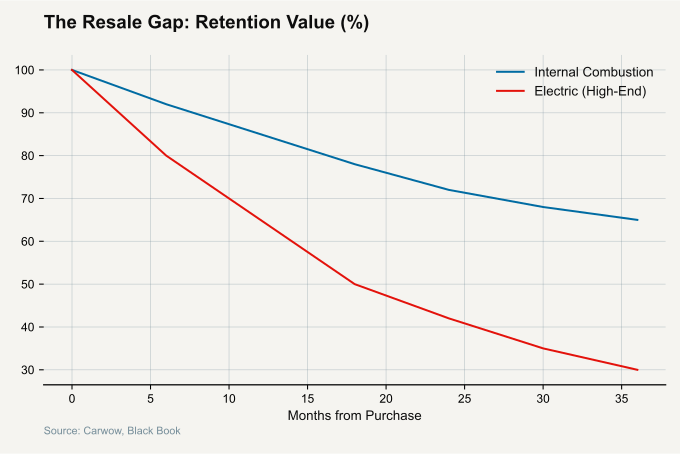
For the average household, a vehicle is the second largest purchase they will ever make. They understand that it will depreciate the moment it leaves the dealership lot, but they rely on that depreciation being predictable. The electric vehicle industry, however, effectively broke this unwritten social contract. Buying a new EV in 2022 turned out to be the financial equivalent of setting a pile of cash on fire merely to verify its flammability. Consumers discovered that these machines age less like a vintage Porsche—which retains value through mechanical longevity—and more like a first-generation iPhone. Because the technology moves so rapidly, today’s cutting-edge long-range model is tomorrow’s obsolete gadget. In the United Kingdom’s used car market, a one-year-old Audi e-tron was recently found to be trading for 27 percent less than a comparable model did just a year prior, while its diesel equivalent held its value. The market is not being cruel; it is accurately pricing the risk of owning the technological equivalent of a "VCR" in a "Netflix" world.
The financial carnage among the manufacturers is even more staggering. Ford recently announced a <span>$</span>19.5 billion write-down as it scrapped plans for its flagship electric F-150 Lightning. In 2021, CEO Jim Farley hailed the Lightning as the "truck of the future." Four years later, it has been consigned to the past, a victim of sales that collapsed by 72 percent year-on-year. This was not a minor accounting adjustment; it was a total surrender. Similarly, General Motors booked a <span>$</span>1.6 billion charge to scale back its own production, and Volkswagen is preparing to close a German plant for the first time in its 88-year history. These are not strategic pivots; they are capitulations. Traditional automakers have realized that without massive subsidies to mask the steep depreciation and higher running costs, the product of the future is something very few people want to buy today.
Even the high priest of the revolution, Elon Musk, has quietly rewritten his gospel. For years, the foundational myth of Tesla’s valuation was the promise of selling 20 million cars per year by 2030—roughly twice the output of Toyota. But with sales hovering below 2 million units and experiencing consecutive years of decline, that ambition has evaporated. Faced with a shrinking car business, the company has done what any cornered tech firm would do: it pivoted to science fiction. The narrative has shifted from shipping cars to developing humanoid robots and full self-driving software—products that are perpetually "coming next year" and conveniently do not require monthly sales reports today. In the modern stock market, a "robot in the bush" is worth significantly more than "two cars in the hand," allowing investors to ignore the uncomfortable present of declining margins in favor of a fantastic future.
The fundamental problem facing Detroit is that the "manufacturing math" of the internal combustion era has been inverted. In the United States, the passenger car is practically extinct; trucks and SUVs now account for 80 percent of new vehicle sales. For decades, this was a gold mine. Big cars cost only marginally more to stamp out than small ones, but they could be sold for significantly higher prices. In the gas-powered world, the bigger the vehicle, the higher the margin. Electrification destroys this logic. In the EV world, the bigger the vehicle, the larger the battery required to move its three-ton (approx. 2,722 kg) frame. Since the battery is the single most expensive component, scaling up doesn't increase your margin; it incinerates it. To achieve a respectable range in an aerodynamic brick like an F-150, the battery becomes so heavy it erodes the vehicle's payload capacity. To keep the price even remotely affordable, the manufacturer has to eat a loss on every unit.
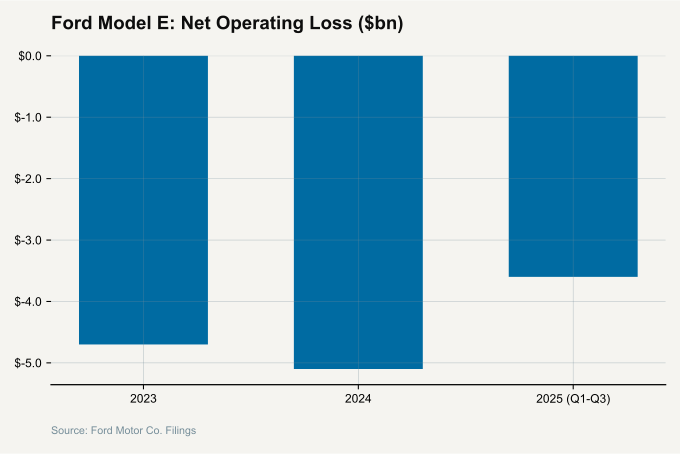
Ford’s Model E division recorded a <span>$</span>5.1 billion operating loss in 2024 and lost another <span>$</span>3.6 billion in the first three quarters of 2025. These are symptoms of a business model that fundamentally conflicts with the American consumer's demand for size. Recognizing this, Detroit is pivoting to a compromise that engineers love and purists hate: the extended-range electric vehicle (EREV). Ford has confirmed that the next iteration of the Lightning will not be fully electric but will carry a small internal combustion engine solely to recharge the battery. It is a tacit admission that for the heavy, aerodynamic disasters that Americans insist on driving, the battery-only solution is a dead end.
The industry has also become dangerously addicted to government handouts to move metal. We have seen repeatedly that demand for EVs is not organic; it is purchased. In Germany, the continent's largest auto market, EV sales collapsed by nearly 40 percent the moment the government withdrew purchase subsidies. Sales only ticked back up when new subsidies were introduced. This stop-start dynamic makes industrial planning impossible. Manufacturers are being asked to invest billions in multi-decade factory projects based on demand that can evaporate overnight if a finance minister tightens a budget or a new administration signs an executive order. The data shows that when the free money stops, the car stops selling.
To understand why the transition has stalled, one must understand the "chasm" between the early adopter and the mainstream buyer. For the last five years, the industry hasn't been selling to the general public; it has been selling to a niche demographic of wealthy, tech-obsessed hobbyists. These buyers treated their EVs like the latest iPhone—a status symbol. They were forgiving of uneven panel gaps, software glitches, or doors that wouldn't open in the cold. Crucially, 84 percent of these early adopters had access to home charging and owned a second gas-powered car for long trips. They didn't need the EV to work; they just needed it to be cool.
The mainstream buyer, however, is not a tech enthusiast; they are a pragmatist looking for a tool. They are cost-conscious, skeptical of technology for the sake of technology, and entirely unforgiving of inconvenience. They generally own only one vehicle, park it on the street, and expect it to work seamlessly for fifteen years. When this buyer sees a <span>$</span>58,000 car that takes 40 minutes to refuel and might lose 30 percent of its range in a Chicago winter, they do not see "the future." They see a downgrade. Automakers fooled themselves into thinking they had solved the puzzle, when in reality, they had merely picked the low-hanging fruit of the wealthy elite.
Nowhere is the disconnect between policy fantasy and industrial reality more glaring than in Europe. On the surface, the transition looked successful; one in five cars sold in the EU this year was electric. In any other industry, capturing 20 percent of a market in a decade would be a triumph. But for European regulators, this was a failure that required emergency intervention because the emissions targets were set to ratchet tighter regardless of actual consumer demand. To avoid billions in penalties, European incumbents have been forced into a humiliating ritual: buying carbon credits from their competitors. Companies like Volkswagen and Stellantis have sent millions of euros to Tesla and Volvo to "pool" their emissions data. From a strategic perspective, this is madness. European manufacturers are effectively subsidizing the very companies trying to put them out of business. It is the corporate equivalent of paying your bully to stop punching you, only to watch him use the money to buy a baseball bat.
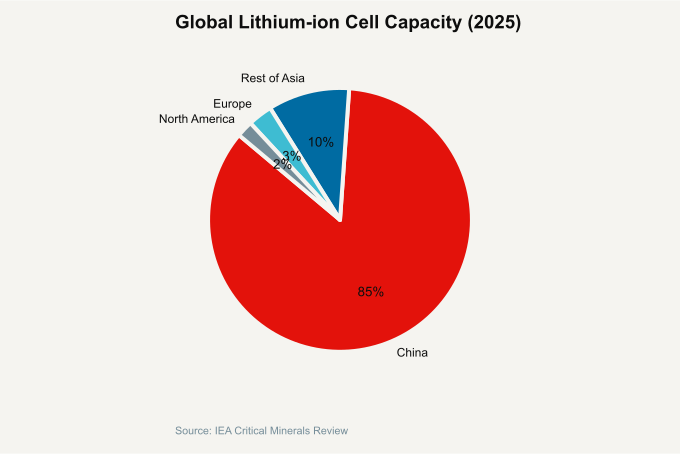
While the West spends the next decade negotiating loopholes and refining hybrid trucks, China is finalizing its stranglehold on the only component that actually matters: the battery. China currently controls 85 percent of global lithium-ion cell manufacturing capacity. For critical minerals like graphite and processed lithium, their dominance is nearly total. This is not a supply chain gap that can be closed with a few tax credits or a new factory in Tennessee; it is a structural monopoly. This forces an uncomfortable question: Is a "German" electric car truly German if its most valuable and complex component is imported from China? When the battery pack accounts for 40 percent of the vehicle's cost, the legacy automaker is reduced to the status of a final assembly plant for Chinese technology.
Western governments are trying to wall off their markets with tariffs, but Chinese manufacturers are simply climbing over the wall. Companies like BYD are already scouting locations for factories inside Europe and Mexico, bringing their supply chains with them. They can build electric vehicles profitably at prices Western legacy automakers cannot match even in their own backyards. Europe's pivot to "green steel" offsets and synthetic fuels might buy its automakers a few more years of profitability from their piston engines, but it does nothing to address the reality that they have lost the battery war.
Furthermore, a new and looming threat to the EV industry has emerged from an unexpected quarter: Big Tech. The electric vehicle is about to enter a bidding war for electricity against the world's best-funded companies. OpenAI is planning to build data centers that will consume 23 gigawatts of power in the next five years—roughly the output of 23 nuclear power stations. Other AI providers are planning similar build-outs. If EVs have to compete with massive AI clusters for grid capacity, the era of "cheap" home charging may come to an end, dismantling the last remaining economic argument for going electric.
The transition to Net Zero has been indefinitely rescheduled. The world is backing away from the edge of the electric cliff. According to Bloomberg, plug-in car sales in the U.S. are expected to plunge 30 percent in the final quarter of this year to their lowest levels since 2022. For next year, analysts project little to no growth. The events of late 2025 mark the end of the "inevitability" narrative. For five years, the global auto industry operated on a timeline dictated by politicians rather than customers, engineers, or economists. They tried to force a technological transition to happen overnight by flooding the market with subsidized capital and banning the competition. That accelerationist experiment has stalled. The economics have simply become undeniable. In 2019, the average new car in the U.S. cost <span>$</span>39,000; today, it costs over <span>$</span>50,000. Consumers are feeling squeezed, and they are rejecting the premium of the electric vehicle.
Western automakers are not "falling behind" in a race; they are realigning with reality. They are pivoting from building the cars regulators wanted them to build back to building the cars their customers actually want to buy. The "truck of the future" may eventually arrive, but it will not be on the timeline of a Brussels bureaucrat or a Silicon Valley visionary. It will arrive when the math finally works—and right now, the numbers are written in red.
References#
- BloombergNEF. (2025). Electric Vehicle Outlook 2025: The Regional Divergence.
- Boston Consulting Group. (2024). The EV Profitability Gap: Why Scale Isn't Saving Detroit.
- Carwow. (2025). Used Car Price Index: EV vs ICE Residual Value Trends.
- Cox Automotive. (2025). 2025 New Vehicle Affordability Report.
- Ford Motor Company. (2025). Q3 2025 Earnings Call and Financial Supplement.
- International Energy Agency. (2024). Global EV Outlook 2024: Trends and Supply Chain Vulnerabilities.
- International Energy Agency. (2025). Critical Minerals Market Review.
- Reuters. (2025, September 12). Volkswagen Considers Historic Plant Closures in Germany Amid EV Slowdown.
- Tesla, Inc. (2025). Annual Shareholder Meeting Presentation.
- U.S. Internal Revenue Service. (2025). Clean Vehicle Tax Credit (Section 30D) Status Update.