The Sticker That Changed Everything#
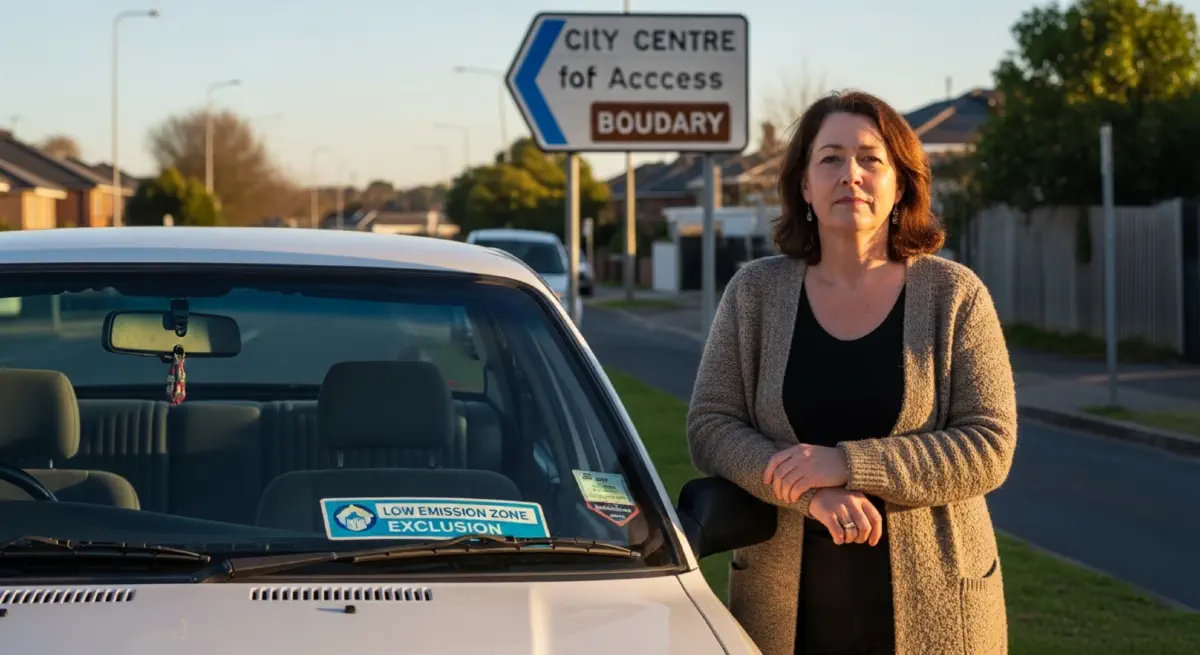
In the spring of 2021, a French schoolteacher living in Vitry-sur-Seine received a letter from Paris's environmental authority confirming what she had been anticipating for two years: her 2011 Peugeot 508 diesel, a Euro 5 vehicle she had purchased second-hand in 2017 for €7,400, had been assigned a Crit'Air 3 vignette and was permanently prohibited from entering the city of Paris during weekday hours. The vehicle had passed every emissions test required of it. It carried a certified NOx rating of 180 mg/km, as authorised by Euro 5 regulation and verified by a Commission-sanctioned laboratory. No manufacturer had contacted her. No remediation fund had offered compensation. Her vehicle was worth approximately €3,100 on the private market — a value that would fall to below €1,800 within 18 additional months as further Crit'Air expansions were announced.
The certificate that defined her vehicle as compliant was produced by the same regulatory system that was now defining it as excluded. She had not been deceived in any legally actionable sense. She had purchased a vehicle that passed every test it was sold under, in a country whose government had subsidised its fuel for decades and whose carmakers had lobbied to preserve the test cycle that made it certifiable. The loss — approximately €4,300 in residual value compression against the vehicle's 2017 purchase price — was hers alone.
The Arithmetic of an Abandoned Fleet#
The stranded asset crisis emerging from Europe's diesel fleet is not a single event. It is a compound process produced by three simultaneous mechanisms: the expansion of urban low-emission zones, driven by air quality litigation and EU infringement proceedings, which removes utility from vehicles whose certification has no legal force against ambient air quality law; a residual value collapse that began with the Dieselgate revelation and has accelerated with each successive LEZ announcement; and a political economy in which every actor positioned to absorb the Regulatory Gap Cost has found structural reasons to displace it to the next party in the ownership chain. Understanding who ultimately bears the diesel reckoning requires tracing all three mechanisms to their common endpoint.
The System That Knows It Cannot Compensate#
The LEZ Architecture and Its Legal Trigger#
As of early 2026, approximately 320 active low-emission zones operate across EU member states, compared to fewer than 70 in 2015. The acceleration has two primary drivers. The first is EU infringement proceedings: Germany, France, Italy, Belgium, and the Czech Republic have all faced formal Commission action for persistent exceedance of the 40 μg/m³ annual mean NO₂ limit, with some proceedings extending through multiple compliance plan cycles without adequate resolution. The second is city-level public health litigation, in which NGOs and municipal governments have sought judicial orders compelling the introduction of vehicle restrictions that national governments declined to impose through legislation.
The German Federal Administrative Court's February 2018 ruling in the Stuttgart and Düsseldorf cases established the pivotal legal precedent. The court held that no vehicle's regulatory certification — Euro 5, Euro 6, any standard — conferred a right to operate in a particular location where ambient air quality law required exclusion. From that ruling, the legal architecture of stranded assethood was complete: a vehicle certified as compliant under one regulatory framework could be excluded as non-compliant under a second framework operating on entirely different premises, and the owner had no sustainable legal claim against either the certifying authority or the manufacturer who had sold compliance.
By 2025, the major EU urban agglomerations have each implemented or formally announced diesel thresholds that are directionally irreversible. Paris permanently excludes all pre-Euro 6d diesel vehicles from an area encompassing the périphérique and beyond. London's Ultra Low Emission Zone charges pre-Euro 6 diesel vehicles £12.50 daily across the full Greater London boundary. Amsterdam has announced exclusion of all diesel passenger cars from the city centre by 2030. Brussels prohibits Euro 5 and earlier diesel from its inner ring road. Milan, Barcelona, and Rome maintain weekend and peak-hour restriction regimes with published tightening schedules. The approximately 80 million pre-Euro 6d diesel vehicles registered in western European metropolitan areas as of 2023 face a policy environment with one directional tendency, and no exit other than depreciation and scrapping.
The Depreciation Curve as a Policy Artifact#
The residual value of a diesel passenger car in western Europe began diverging from pre-Dieselgate depreciation baselines in late 2015 and has not recovered. The divergence follows a specific pattern: an initial shock driven by reputational damage to diesel technology broadly, followed by incremental step-downs triggered by each new LEZ expansion or announcement, compounding into a structural repricing of the diesel fleet's utility value.
Autovista Group's European residual value analysis documented the scale of this repricing in detail. A Euro 5 diesel C-segment vehicle that would have held 40% of its new-car value at three years old in 2014 retained approximately 31% by 2019 — a 9-percentage-point compression. On an average new-car price of €27,000 for that segment, the compression represents approximately €2,430 of absorbed depreciation per vehicle that had not been anticipated when purchase or financing decisions were made. By 2023, as LEZ expansions consolidated, the equivalent three-year residual had fallen to below 24% in France and Germany — a 16-point compression against the 2014 baseline, representing roughly €4,320 per vehicle in absorbed capital loss.
This depreciation is not uniformly distributed across the ownership lifecycle. Consumers in the first ownership cycle — those who purchased new Euro 4 and Euro 5 diesels between 2008 and 2014 on three- to five-year finance agreements — typically exited their loans before the full residual collapse. Their losses were real but moderated by timing. Second and third owners — disproportionately lower-income households in peri-urban areas, for whom a used diesel at €6,000–9,000 represented accessible mobility to employment unavailable by other means — purchased vehicles in 2015 through 2021 at prices already beginning to reflect rising uncertainty, and now bear the full forward depreciation of a vehicle whose utility diminishes with each LEZ extension. The demographic distribution of RGC absorption is therefore inverted relative to the distribution of new-car revenue. The manufacturers who captured €25,000–40,000 at point of sale bear settlement costs of, at most, €2,000–3,500 per vehicle under the most expansive regulatory actions. The second-owner bears the compounding residual loss with no avenue of recovery.
The Political Economy of Cost Displacement#
The EU's institutional response to the stranded diesel fleet has been consistent in one dimension: every mechanism deployed has diffused the adjustment cost outward, toward the final asset holder, rather than concentrating it on the parties who captured upstream revenue or maintained the upstream regulatory failure.
The Commission's Clean Vehicles Directive encourages but does not mandate fleet transition timelines or manufacturer compensation obligations. Euro 7, finalised in 2024, governs new vehicle emissions from its implementation date forward; it creates no retroactive liability framework for the certified-gap NOx of vehicles already on the road. The Dieselgate criminal proceedings in Germany culminated in a 2024 suspended sentence for former Volkswagen CEO Martin Winterkorn — with no individual financial restitution directed to affected communities. German class action settlements, facilitated by 2018 legislation, averaged €1,500–3,500 per affected vehicle: less than the documented residual value compression in most ownership scenarios, and entirely disconnected from the RGC health externality.
Member states have deployed scrappage incentive programmes — France's prime à la conversion, Germany's Umweltbonus — structured as demand stimulation instruments for new vehicle purchases, primarily EVs. These schemes transfer public funds toward new-car purchases at per-vehicle rates of €2,500–6,000. They recover a fraction of the documented depreciation loss, redirect spending toward manufacturer revenue streams, and are architecturally designed without reference to the RGC. They do not compensate the health externalization the old vehicle generated. They compensate for one portion of the asset impairment, at a rate that makes the policy look responsive while leaving the aggregate liability structurally undisturbed.
The Balance Sheet of a Policy That Ended Without an Audit#
The diesel fleet will be driven off European roads over the next fifteen years through the compound effect of LEZ exclusion, residual value erosion, uneconomical repair costs on ageing platforms, and eventual physical end-of-life. Each year of this process allocates a portion of the Regulatory Gap Cost that the certification system deferred. It is not allocated by audit. It is absorbed by proximity: the urban resident with deteriorating air quality absorbed the health cost; the municipal government implementing LEZ infrastructure absorbs the administrative and enforcement cost; the second-owner absorbs the capital loss; and the taxpayer funds the scrappage incentive that partially compensates the loss without pricing its cause.
The aggregate RGC for the European diesel passenger fleet across Euro 2 through Euro 6b generations — approximately 250 million vehicles, weighted across the generational liability profile established in the preceding post — falls conservatively in the range of €90–130 billion. The total of all Dieselgate fines, civil settlements, buyback programmes, and remediation commitments globally, across all manufacturers through 2025, does not reach €50 billion. The gap between those two figures is not a residual legal claim awaiting a court. It is the portion of the fossil-fuel combustion economy's externalized social cost that the certification framework was designed, over 44 years of operational discipline, to make invisible. Its invisibility was not an oversight. It was a policy choice, maintained with remarkable consistency by institutions whose mandate was to see it.
The diesel reckoning is, finally, not a story about Wolfsburg. It is a story about a continent that chose the wrong variable to measure, maintained that choice against documented evidence for two decades, and is now distributing the cost of that choice to the parties least equipped to absorb it — and most distant from the decisions that produced it.