The Certification Gap Was Known Before the Scandal: European Commission Joint Research Centre data documented real-world diesel NOx exceedance factors of 4–7× from 2001 onward. The ICCT published a definitive cross-manufacturer study 14 months before the EPA's Volkswagen notice of violation. Dieselgate was not a discovery; it was a forced acknowledgment of a gap that regulators and manufacturers had negotiated around for a decade.
The Regulatory Gap Cost Inverts the Settlement Narrative: The RGC formula — $(E_{real} - E_{certified}) \times VMT_{lifetime} \times C_{health}$ — produces per-vehicle health liabilities of €432 (Euro 2) to €1,541 (Euro 5). Applied to the full Euro 4 and Euro 5 passenger fleet of approximately 90 million vehicles, the aggregate European air shed health liability exceeds €108 billion. The total of all global Dieselgate settlements across all manufacturers through 2025 does not reach €50 billion. The widely cited €33 billion VW settlement, framed as the largest automotive penalty in history, covered less than 17% of the VW Group's own estimated RGC for European operations.
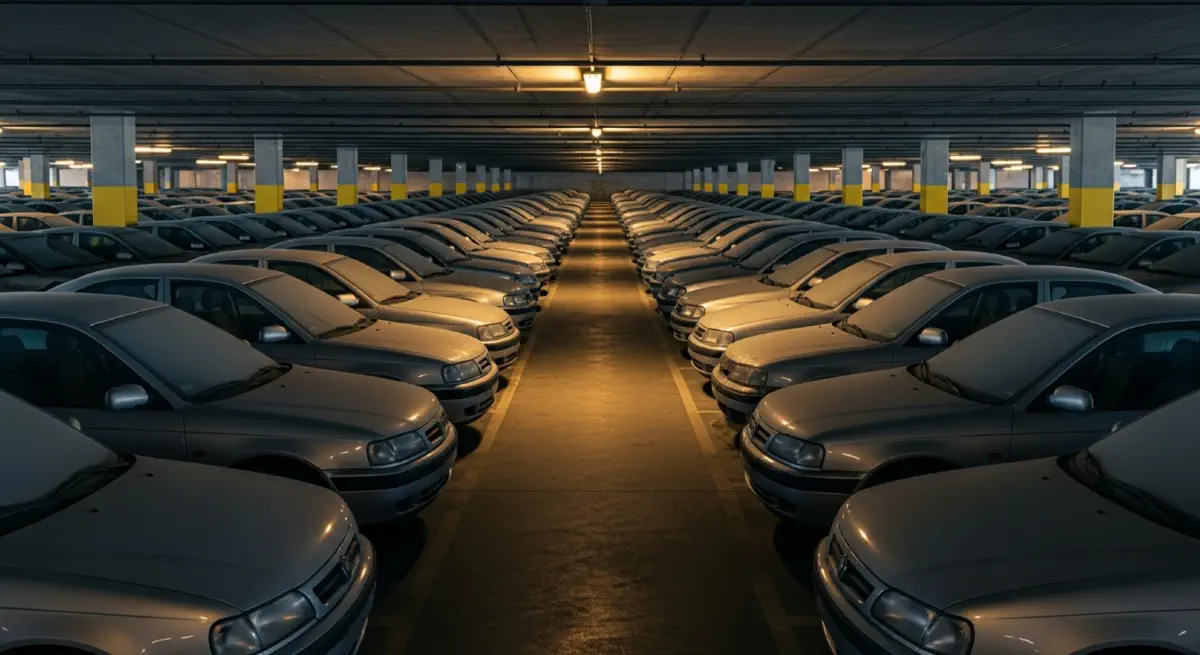
CO₂-Only Regulation Structurally Produced the NOx Crisis: The EU's fleet-average CO₂ penalties created a €950 million annual incentive for a one-million-unit manufacturer to shift 20% of production to diesel. The fuel tax differential removed the consumer-level cost brake. The NEDC test cycle removed the emissions performance constraint. These three instruments operated simultaneously, transparently, and in documented alignment. No conspiracy was required to produce 250 million potentially stranded assets; the incentive architecture was sufficient.
The Test Cycle's Reform Delay Was a Political Choice, Not a Technical Failure: Qualified majority voting requirements in the EU Council gave Germany, France, Italy, and the Czech Republic — the four member states housing Europe's dominant automotive manufacturers — effective blocking power over NEDC revision. The transition to WLTP and mandatory Real Drive Emissions testing, proposed from 2007, was delayed until 2017 by identifiable political obstruction. When the regulation finally required actual road testing, conformance factors fell from 6–7× to 1.3–1.6× within two vehicle generations. The prior divergence was not an engineering problem awaiting a technical solution. It was a regulatory exemption awaiting removal.
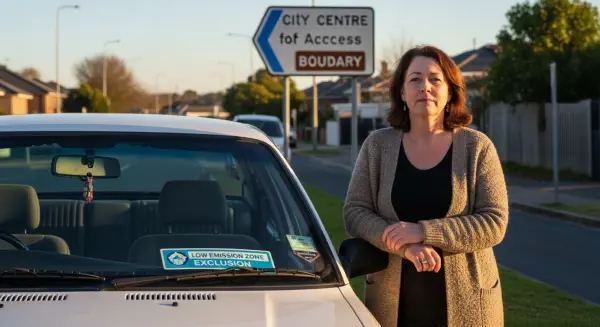
The Stranded Asset Cost Falls on Those Furthest from the Upstream Revenue: Corporate Dieselgate settlements were calibrated to legal exposure and political bandwidth. Scrappage incentive programmes were calibrated to stimulate new vehicle demand. Neither instrument was calibrated to the RGC. The residual value collapse — 16 percentage points below the 2014 depreciation baseline for Euro 5 C-segment vehicles by 2023 — is absorbed disproportionately by second and third owners: lower-income, peri-urban households for whom used diesel was the accessible mobility option, and who had no standing to participate in the regulatory decisions that created and then abandoned it.
European Commission. (2009). Regulation (EC) No 443/2009 of the European Parliament and of the Council setting emission performance standards for new passenger cars. Official Journal of the European Union, L 140.
European Commission Joint Research Centre. (2011). Characterisation of real driving emissions from passenger cars (JRC Technical Report EUR 24697 EN). Publications Office of the European Union.
International Council on Clean Transportation. (2014). Real-world exhaust emissions from modern diesel cars: A meta-analysis of PEMS emissions data from EU (Euro 6) and US (Tier 2 Bin 5/ULEV II) diesel passenger cars. ICCT White Paper.
International Council on Clean Transportation. (2015). Discrepancy between type-approval and real-world fuel consumption and CO₂ values: Assessment for 2001–2013 European passenger cars. ICCT White Paper.
European Environment Agency. (2019). Air quality in Europe — 2019 report (EEA Report No 10/2019). EEA.
Transport & Environment. (2016). Mind the gap 2016: Closing the chasm between test and real-world car CO₂ emissions. Transport & Environment.
European Commission. (2014). CAFE Programme: Baseline analysis for the Review of the EU National Emission Ceilings Directive (Service Contract No. 070201/2005/414294/MAR/C1). DG Environment.
European Commission ExternE Project. (1995). Externalities of energy, Vol. 2: Methodology (Report EUR 16521 EN). European Commission.
Bundesverwaltungsgericht. (2018, February 27). BVerwG 7 C 26.16 — Diesel Fahrverbote Stuttgart und Düsseldorf. Bundesverwaltungsgericht.
Autovista Group. (2020). Diesel residual value outlook: Long-term impact of low-emission zone expansion on diesel used-car values in western Europe. Autovista Intelligence.
Brugge, D., Durant, J. L., & Rioux, C. (2007). Near-highway pollutants in motor vehicle exhaust: A review of epidemiologic evidence of cardiac and pulmonary health risks. Environmental Health, 6(1), 23. https://doi.org/10.1186/1476-069X-6-23
Volkswagen AG. (2024). Annual report 2023: Legal proceedings and provisions related to diesel emissions issues. Volkswagen AG.
European Court of Justice. (2020). Joined Cases C-110/18 and C-220/18: Commission v. Federal Republic of Germany — infringement proceedings for NO₂ limit value exceedance. EUR-Lex.
Anenberg, S. C., Miller, J., Minjares, R., Du, L., Henze, D. K., Lacey, F., Malley, C. S., Emberson, L., Franco, V., Klimont, Z., & Heyes, C. (2017). Impacts and mitigation of excess diesel-related NOx emissions in 11 major vehicle markets. Nature, 545(7655), 467–471. https://doi.org/10.1038/nature22086
Posada, F., Chambliss, S., & Blumberg, K. (2015). Costs of emission standards for new diesel vehicles in Europe. International Council on Clean Transportation.