The chemical and economic friction of battery circularity#
The lithium-ion battery in a modern electric vehicle is a dense, high-voltage sandwich of cobalt, nickel, manganese, and lithium, weighing hundreds of kilograms (~450 kg to 600 kg) and engineered to survive a decade of thermal cycling and vibration. It is a masterpiece of precision manufacturing. But when the car is finally crushed, this sophisticated component is reduced to a pile of dark, gritty dirt known as "black mass." This substance is the raw material for a promised circular economy, yet the transition from this industrial dust back into a functioning battery is currently snagged on a series of chemical and economic realities that no amount of corporate optimism has yet smoothed over.
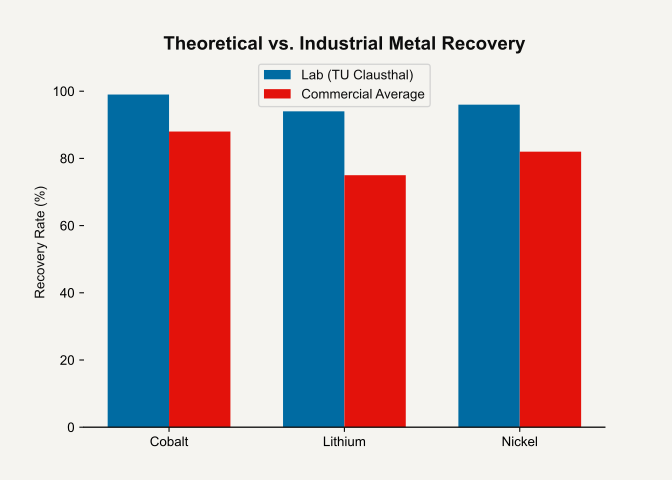
We are told that we can recover more than 90% of the materials from old batteries. On paper, and in the pristine, controlled environment of a university laboratory like TU Clausthal, the numbers are even more seductive. Using a process called hydrometallurgical recycling, researchers can recover more than 99% of a specific metal like cobalt. They achieve this by dissolving the black mass in sulfuric acid—a liquid so corrosive it causes immediate severe burns on contact—and then putting it through a series of solvent extractions that change the liquid’s color from a deep, ink-like blue to a vibrant red as the metals are isolated. It is a slow, steady, and meticulous batch process. But what works in a beaker for a doctoral thesis often fails the test of the balance sheet. The precision of the lab is an artifact of its isolation from the messy, variable inputs of the real world.
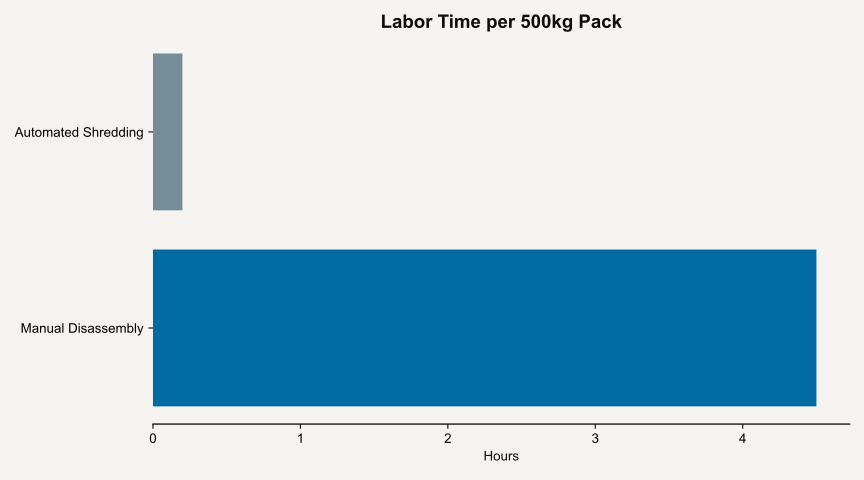
The first friction point is the physical geometry of the batteries themselves. There is no standard for how an EV battery is built. Every manufacturer has a proprietary design for how the cells are arranged, how they are cooled, and how they are wired. Because of this lack of standardization, the initial stage of recycling—discharging the battery and taking it apart—must be done by hand. It is a labor-intensive, expensive bottleneck that machines currently cannot navigate. You cannot automate the dismantling of a thousand different puzzles, each glued and bolted together with a unique corporate logic. A technician must carefully navigate high-voltage connectors and potent adhesives, sometimes spending hours on a single 1,200 lb (~544 kg) pack that a robot would simply crush, losing the valuable internal structure.
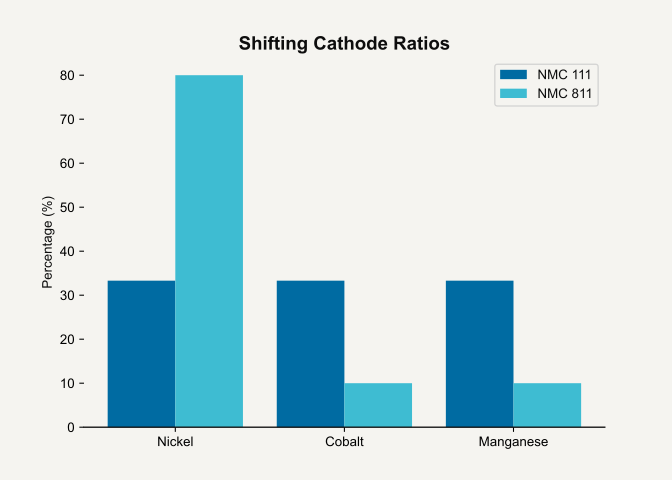
Once the battery is shredded and the "black mass" is isolated, the chemistry becomes the next obstacle. The industry is currently in a "wild west" phase of manufacturing. One battery might use a Lithium Nickel Manganese Cobalt (NMC) chemistry in a 1:1:1 ratio, while another uses an 8:1:1 ratio, and a third might be Lithium Iron Phosphate (LFP). A commercial recycling plant must be built to handle these specific proportions. If a plant is optimized to precipitate large amounts of cobalt from older 1:1:1 batteries, its equipment becomes a stranded asset if the market shifts toward 8:1:1 batteries that are mostly nickel. The cost of building a plant robust enough to handle every possible chemical combination—the massive separators, the specific precipitation tanks—is prohibitive. The engineering must be "robust," which in industrial terms is a synonym for "expensive."
Even if the chemistry were solved, the environment remains a casualty of the process. While hydrometallurgy is touted as a low-energy, low-temperature alternative to smelting, it is not a clean operation. The process generates toxic fumes like hydrogen sulfide (H2S) and hydrogen fluoride (HF). These are not minor inconveniences; they are lethal byproducts of upscaling. In Hungary, a high-tech battery factory made headlines after recording high levels of cancer-causing heavy metals in the air, having failed to properly filter its exhaust gases. The "green" solution of recycling often requires its own set of industrial scrubbers and hazardous waste management systems that eat into the thin margins of the business. The irony is that the recycling process, intended to save the environment, can become a localized ecological disaster if the filtration systems are not perfectly maintained—a cost that many operators find difficult to justify in a low-margin market.
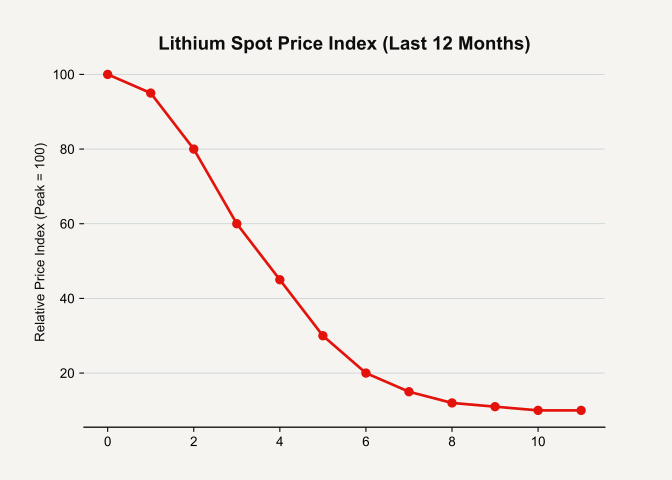
Margins, ultimately, are where the circular economy goes to die. The profitability of recycling is tied to the volatile spot prices of the metals recovered. A year ago, lithium prices were eight to ten times higher than they are today. When prices are high, recyclers can make a profit, with some estimates from consulting firms like McKinsey suggesting a revenue of $800 to $1,600 per metric ton (~1.1 US tons) of battery processed. But when prices drop, as they have recently, the cost of the sulfuric acid, the manual labor, and the environmental compliance exceeds the value of the recovered dirt. If a recycler has to pay for the dead batteries rather than receiving them for free, the economics often flip: it becomes cheaper to simply mine new materials from the earth than to scrub them out of old black mass. The market does not reward circularity; it rewards the lowest price per unit of material.
The labor statistics of this industry are particularly revealing. To safely dismantle a 1,000 lb (~454 kg) battery pack, the labor hours required are significant. While shredding is fast, it produces a lower quality of black mass filled with copper and aluminum impurities. To get the 95% purity levels required for efficient metal recovery, you need cleaner inputs. This creates a Catch-22: you can have cheap, dirty recycling via shredding, or expensive, clean recycling via manual disassembly. The current market cannot comfortably afford either.
There is a final, crowning irony in the struggle to scale battery recycling: a lack of "feedstock." We are building more electric cars than ever, but their batteries are lasting longer than the early, pessimistic projections suggested. Furthermore, a battery that is no longer fit for a car—perhaps it has only 70% of its original capacity—is still perfectly useful for stationary energy storage, such as holding solar power for a home or a grid. These batteries are being diverted into a "second life," delaying their arrival at the recycling plant by another decade. The recyclers have built the cathedrals of chemistry, but the worshippers haven't arrived.
The black mass remains a pile of potential, a dark grit that contains the future of transportation, yet it is currently held in a state of suspended animation by the laws of thermodynamics and the whims of the London Metal Exchange. We have proven we can do it in a lab. We have yet to prove we can do it without losing our shirts or poisoning the air. The circle is not yet closed; it is jagged, expensive, and smells of sulfuric acid.
References#
- McKinsey & Company. (2023). Battery recycling: A key to sustainable electric mobility.
- TU Clausthal University of Technology. (2024). Hydrometallurgical Recovery and Metal Separation Research Papers.
- London Metal Exchange (LME). (2024). Historical Lithium and Cobalt Pricing Data.